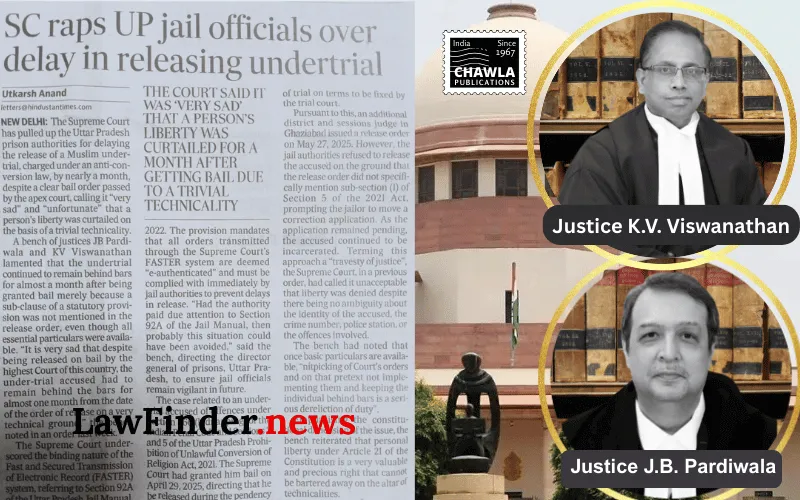
Supreme Court directs Uttar Pradesh to compensate detainee for undue jail time due to procedural lapses
In a significant judgment emphasizing the sacrosanct nature of personal liberty, the Supreme Court of India has ordered the State of Uttar Pradesh to pay a compensation of Rs. 5,00,000 to Aftab, a petitioner who faced wrongful detention owing to procedural lapses. The judgment, delivered on December 16, 2025, underscores the importance of adhering to court orders promptly to prevent undue detention and technical hindrances.
The case involved Aftab, who was granted bail by the Supreme Court on April 29, 2025, in connection with charges under Section 366 of the Indian Penal Code and Sections 3 and 5 of the Uttar Pradesh Prohibition of Unlawful Conversion of Religion Act, 2021. Despite the bail order, Aftab remained in custody due to the non-mentioning of sub-section (1) of Section 5 in the release order, prompting the petitioner to seek modification of the order.
The Supreme Court, in its order, expressed dismay over the technicality causing the delay in Aftab's release and directed an inquiry into the lapses. The court highlighted the urgent need for authorities to act on the substance of court orders rather than nitpicking over trivial errors. The judgment also stressed that orders transmitted via the Supreme Court's Fast and Secured Transmission of Electronic Records (FASTER) system must be complied with immediately by jail authorities.
The Supreme Court further directed the Director General of Prisons, Uttar Pradesh, to conduct a thorough inquiry to fix accountability for the delay in releasing Aftab and sensitize prison officers about respecting court orders and prioritizing individual liberty. The inquiry revealed that procedural lapses were responsible for the delay, prompting the court to award ad hoc monetary compensation to Aftab as provisional relief.
Justice J.B. Pardiwala and Justice K.V. Viswanathan, who presided over the case, emphasized that liberty is a precious right guaranteed under Article 21 of the Constitution and should not be compromised on technical grounds. The court expressed hope that no other under-trial would languish in jail due to similar technicalities and directed the Director General of Prisons to ensure vigilance in future cases.
This landmark judgment serves as a reminder of the judiciary's role in upholding the rights of individuals and ensuring that procedural lapses do not infringe upon personal liberty.
Bottom Line:
Liberty of an individual is a precious right guaranteed under Article 21 of the Constitution of India, and it cannot be compromised on technical grounds. Authorities must ensure prompt compliance with court orders to prevent undue detention.
Statutory provision(s): Article 21 of the Constitution of India, Uttar Pradesh Prohibition of Unlawful Conversion of Religion Act, 2021 Section 5, U.P. Jail Manual, 2022 Section 92A.
Aftab v. State of Uttar Pradesh, (SC) : Law Finder Doc Id # 2827163