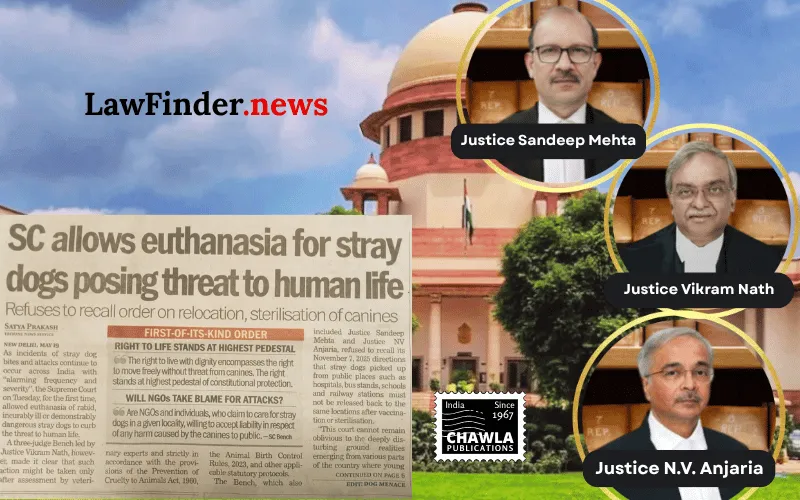
Apex Court clarifies that Animal Birth Control Rules, 2023 do not mandate reintroduction of sterilised dogs into sensitive areas such as schools and hospitals, directs States and municipal authorities to strengthen infrastructure and ensure accountability
In a landmark judgment dated May 19, 2026, the Supreme Court of India delivered a comprehensive ruling in the suo moto writ petition titled "City Hounded By Strays, Kids Pay Price," addressing the escalating menace of stray dogs attacking citizens, particularly children, within public and institutional premises. The Court underscored the constitutional mandate under Article 21, which guarantees the right to life and safety, emphasizing that public safety must take precedence in managing stray dog populations.
The judgment arose from widespread reports of increasing dog bite incidents across the country, including alarming cases within educational institutions, hospitals, sports complexes, bus depots, and railway stations. The Court noted that the existing implementation of the Animal Birth Control Rules (ABC Rules), 2023, which adopt the Capture-Sterilise-Vaccinate-Release (CSVR) model, had been inadequate and ineffective, resulting in an unchecked proliferation of stray dogs and consequent risks to human safety.
A key issue before the Court was whether stray dogs found within institutional and restricted-access premises could be classified as "street dogs" or "community dogs" entitled to re-release into the same locality after sterilisation and vaccination, as mandated by Rule 11(19) of the ABC Rules, 2023. The Court held that such institutional premises do not fall within the ambit of "locality" or "street" as defined under the Prevention of Cruelty to Animals Act, 1960, and therefore, the statutory requirement of re-release does not apply to these sensitive areas. This clarifies that stray dogs found in schools, hospitals, transport hubs, and similar spaces must be removed and relocated to designated shelters without reintroduction to the same premises.
The Court also addressed submissions challenging the validity of the Standard Operating Procedures (SOPs) issued by the Animal Welfare Board of India (AWBI) in compliance with the Court's directions. The SOPs extend the framework for stray dog management to various public spaces beyond institutional premises, such as parks, religious places, and tourist sites. The Supreme Court upheld the SOPs, noting that the categories listed were illustrative and aimed at protecting public safety in all high-footfall areas.
Further, the Court rejected requests for constituting an expert committee, holding that the issues were sufficiently defined and that effective implementation of existing statutory provisions and judicial directions was paramount. It emphasized that infrastructural constraints cited by some parties were overstated and that existing shelters and resources could be optimally utilised.
The Court highlighted serious lapses in the implementation of the ABC framework by States, Union Territories, and municipal authorities, including insufficient sterilisation centres, lack of trained personnel, and inadequate monitoring. It noted disturbing statistics from various States, with hundreds of thousands of dog bite cases and numerous deaths reported annually, underscoring the urgency of the matter.
In its directions, the Supreme Court mandated States and Union Territories to:
- Identify all government and private institutional premises and secure them against the ingress of stray dogs through fencing and administrative measures;
- Remove stray dogs from such premises and relocate them to shelters following sterilisation and vaccination, without re-release to the original location;
- Establish and operationalise Animal Birth Control Centres with adequate infrastructure and trained personnel in every district;
- Ensure availability of anti-rabies vaccines and immunoglobulin in all government medical facilities;
- Conduct public awareness programs in schools and other institutions on preventive behaviour and first aid for dog bites;
- Monitor compliance and file periodic affidavits on the status of implementation.
The Court also clarified that animal welfare organisations and groups caring for stray dogs within institutional premises must assume tortious liability for any harm caused by the animals. Institutions permitting such activities must secure formal undertakings regarding accountability.
Importantly, the Supreme Court invoked its plenary powers under Article 142 of the Constitution to supplement the statutory framework where necessary to ensure complete justice, noting that the directions issued do not contravene but rather supplement the ABC Rules, 2023 by addressing their limitations in sensitive institutional contexts.
To ensure effective enforcement, the Supreme Court directed all High Courts to register suo moto writ petitions to monitor compliance within their jurisdictions. It warned that persistent non-compliance by officials would attract contempt and other legal proceedings.
The judgment marks a significant judicial intervention balancing animal welfare concerns with the paramount constitutional right to life and safety. It calls for coordinated, sustained action by the State, municipal bodies, and stakeholders to mitigate the public health and safety crisis posed by stray dogs, particularly in vulnerable institutional settings.
Bottom Line:
The Supreme Court of India issued a comprehensive set of directions to address the escalating menace of stray dog attacks and the systemic failures in the implementation of the Animal Birth Control Rules, 2023, emphasizing the constitutional mandate under Article 21 to safeguard human life and public safety.
Statutory provision(s): Constitution of India, 1950, Article 21, Article 142; Prevention of Cruelty to Animals Act, 1960, Section 2(i); Animal Birth Control Rules, 2023, Rules 7(2), 11(19)
In Re: "City Hounded By Strays, Kids Pay Price", (SC) : Law Finder Doc id # 2901719