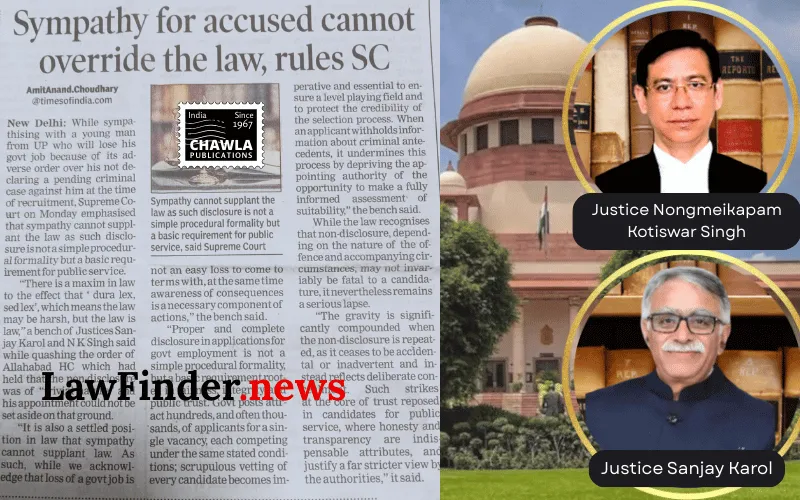
Apex Court Rules Honesty and Integrity Paramount in Government Employment Applications
In a landmark judgment, the Supreme Court of India has reinforced the importance of honesty and transparency in government employment processes, dismissing an appeal by the State of Uttar Pradesh and ruling against Dinesh Kumar, who had concealed material information regarding his criminal antecedents during the application process for a government position.
The bench, comprising Justices Sanjay Karol and Nongmeikapam Kotiswar Singh, delivered the judgment on January 12, 2026, in Civil Appeal No. 196 of 2026. The court emphasized that submission of false information or suppression of material facts in attestation and verification forms constitutes deliberate concealment, rendering a candidate ineligible for government service.
The case originated when the Uttar Pradesh Public Service Commission held an examination for the recruitment of Samiksha Adhikari/Sahayak Samiksha Adhikari in 2021. Dinesh Kumar, the respondent, was selected and asked to submit attestation and verification forms, which he filled out without disclosing two pending criminal cases against him. These included Case Crime No. 198 of 2019 under various sections of the Indian Penal Code (IPC) and Case Crime No. 215 of 2018 under the IPC and the Protection of Children from Sexual Offences Act, 2012.
The concealment was discovered during a character verification process by the Superintendent of Police, which contradicted the respondent's submitted information. Despite a subsequent affidavit by Kumar disclosing the pending cases and a favorable opinion by the District Magistrate regarding his suitability for the position, his appointment was canceled by the appellants, leading to the current legal proceedings.
Initially, the Single Judge of the High Court allowed Kumar's writ petition, citing factors such as his self-disclosure and lack of a charge sheet in the pending cases. However, the Supreme Court overturned this decision, emphasizing that the integrity of the selection process was compromised by Kumar's initial non-disclosure.
The Court highlighted that the disclaimer in the application forms clearly stated that providing false information or concealing material facts would result in disqualification. Furthermore, subsequent acquittals or voluntary disclosures could not rectify the initial suppression of information.
In their judgment, the Justices reiterated that sympathy for the respondent's circumstances, including his age and the potential loss of employment, could not override legal principles. The Court underscored that adherence to the law and procedural fairness must take precedence over personal considerations.
The appeal was thus allowed, reinforcing the legal precedent that honesty and integrity are non-negotiable attributes for candidates seeking government employment. The judgment serves as a stern reminder of the consequences of falsification in official processes.
Statutory provision(s): Indian Penal Code, 1860, Protection of Children from Sexual Offences Act, 2012
State of U.P. v. Dinesh Kumar, (SC) : Law Finder Doc Id # 2836633