Supreme Court Cancels Bail of Accused in Forged Degree Scam - Apex Court directs accused to surrender within two weeks, scrutinizes bail proceedings for suppression of facts and criminal antecedents.
In a significant ruling, the Supreme Court of India has set aside the bail granted to Mazahar Khan by the Allahabad High Court, directing him to surrender within two weeks. The decision came in the case involving allegations of a large-scale scam related to the fabrication of legal qualifications and academic certificates, primarily affecting the legal profession in Uttar Pradesh.
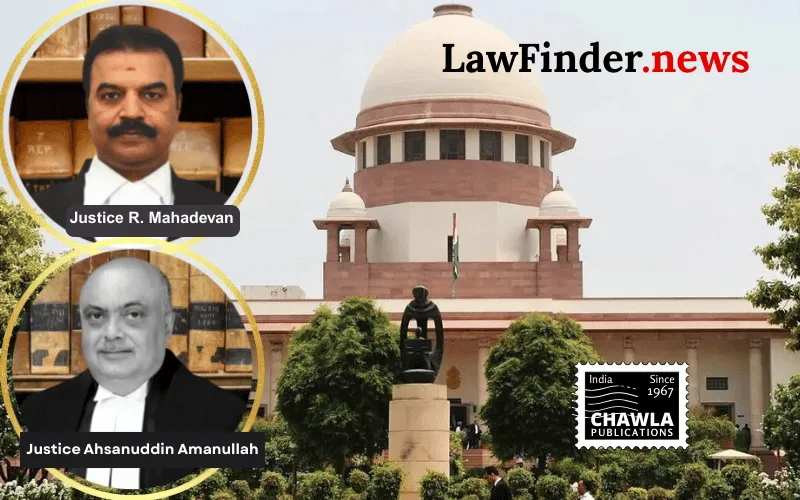
The case, titled "Zeba Khan v. State of U.P.", saw the Supreme Court bench comprising Justices Ahsanuddin Amanullah and R. Mahadevan scrutinize the High Court's decision to grant bail based on suppressed criminal antecedents and disputed documents presented by the accused, Mazahar Khan. The Supreme Court held that the High Court's reliance on these documents, whose genuineness is at the core of the criminal prosecution, and the failure to consider Mazahar Khan's criminal history, rendered the bail order legally untenable.
The prosecution alleged that Mazahar Khan, during his residence in Maharashtra, procured forged Bachelor of Laws (LL.B.) degrees and marksheets from the Sarvodaya Group of Institutions, falsely affiliated with Veer Bahadur Singh Purvanchal University, Jaunpur. These forged credentials were allegedly used to project himself as an advocate, deceiving courts and public authorities, thus posing a severe threat to the integrity of the legal system.
The Supreme Court emphasized the importance of judicial discretion in bail proceedings, underscoring that an order granting bail does not enjoy immunity from appellate scrutiny when shown to be arbitrary or perverse. It reiterated that the grant of bail is subject to judicial discipline and must conform to established legal principles, considering factors such as the nature of accusations, criminal antecedents, societal impact, and suppression of material facts.
The Court noted that Mazahar Khan had suppressed details of nine FIRs registered against him, which included serious offenses like forgery, cheating, and intimidation. This suppression materially influenced the High Court's decision, warranting annulment of the bail order. The Supreme Court also declined the appellant's request for transferring the investigation to a special agency, citing the completion of investigation and lack of evidence demonstrating bias or malfeasance by the State Police.
Further, the Supreme Court stressed the need for full disclosure in bail applications, recommending a framework for illustrating case details, custody, trial status, criminal antecedents, and previous bail applications to ensure transparency and uniformity in judicial proceedings.
Bottom Line:
Bail granted on suppression of criminal antecedents and reliance on disputed material is legally untenable and liable to be annulled. Accused's role in an organised racket involving forged educational degrees poses a serious threat to the legal profession and public trust in the justice system.
Statutory provision(s): Criminal Procedure Code, 1973 - Section 439, Indian Penal Code, 1860 - Sections 419, 420, 467, 468, 471, Bharatiya Nagarik Suraksha Sanhita, 2023 - Sections 318(4), 318(2), 336(3), 340(2), 3(5).
Zeba Khan v. State of U.P., (SC) : Law Finder Doc id # 2852046