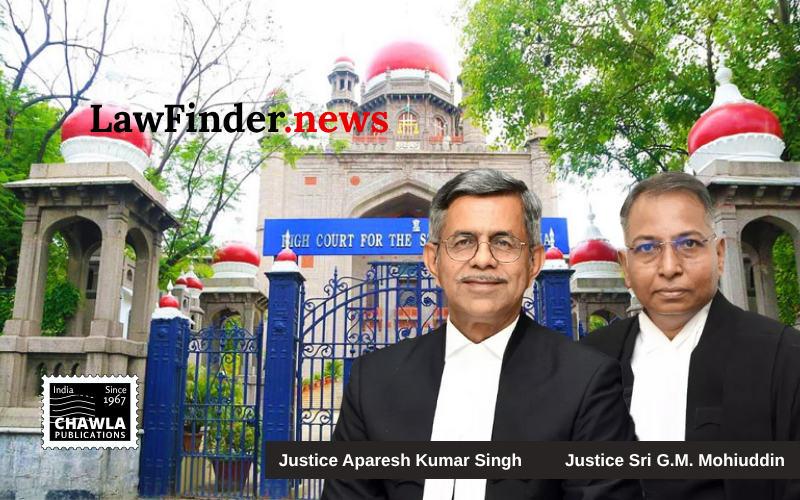
Court Stays Telangana Government's Order Overstepping 50% Reservation Ceiling, Directs Open Category Elections
In a significant ruling, the Telangana High Court has stayed the implementation of the Government of Telangana's order that sought to provide a 42% reservation to Other Backward Classes (OBCs) in local bodies, effectively breaching the 50% reservation ceiling established by the Supreme Court of India. The division bench, comprising Chief Justice Aparesh Kumar Singh and Justice G.M. Mohiuddin, delivered the judgment on October 9, 2025, in response to multiple writ petitions challenging the government's decision.
The court's ruling addressed the Government Order (G.O.) Ms. No. 9, dated September 26, 2025, along with G.O.Ms.Nos. 41 and 42, which outlined guidelines for reservation allocation in Mandal Praja Parishads, Zilla Praja Parishads, and Gram Panchayats under the Telangana Panchayat Raj Act, 2018. The petitioners argued that these orders violated the statutory ceiling of 50% on reservations set forth by Supreme Court precedents, including Vikas Kishanrao Gawali v. State of Maharashtra and K. Krishna Murthy v. Union of India.
The court emphasized the importance of adhering to the "Triple Test" mandated by the Supreme Court for OBC reservations in local bodies. This test requires setting up a dedicated commission to conduct empirical inquiries into the backwardness of communities, determining reservation proportions based on the commission's recommendations, and ensuring that total reservations do not exceed 50%. The court found that the Telangana government's orders had not adequately complied with these prerequisites.
In its judgment, the High Court directed the State Election Commission to notify proportionate seats as open category seats and proceed with the elections, as per the Supreme Court's interim orders in Rahul Ramesh Wagh v. State of Maharashtra. The court clarified that while the election process itself was not being stayed, the orders increasing OBC reservations were temporarily halted pending a final decision.
The judgment also discussed the legislative competence of the state government, noting that the Telangana Backward Classes Reservation Bill, 2025, which aimed to amend relevant sections of the Panchayat Raj Act and Municipalities Act, was yet to receive assent from the Governor. The court underscored that until legislative procedures are completed and the triple test requirements are met, the impugned orders cannot be enforced.
This decision has been welcomed by the petitioners, who argued that the government's move was unconstitutional and lacked proper empirical backing. The state government, represented by Senior Counsel Dr. A.M. Singhvi and Advocate General A. Sudershan Reddy, contended that the orders were based on comprehensive socio-economic surveys and aimed at fair representation for OBCs, but the court found this insufficient under current legal standards.
The court's interim stay on these government orders is seen as a significant enforcement of constitutional mandates on reservation policies and underscores the judiciary's role in ensuring adherence to established legal frameworks.
Bottom Line:
Reservation in Local Bodies - Government of Telangana providing 42% reservation for Backward Classes (BCs) in Local Bodies, resulting in breaching the 50% ceiling limit for reservations - G.O.Ms.Nos.9, 41, and 42 stayed by the High Court - Compliance with the "Triple Test" laid down by the Supreme Court is mandatory before providing reservation for OBCs in Local Bodies.
Statutory provision(s): Constitution of India Articles 243D(6), 243T(6), and 243-O; Telangana Panchayat Raj Act, 2018; Telangana Municipalities Act, 2019
Buttemgari Madhava Reddy v. State of Telangana, (Telangana)(DB) : Law Finder Doc Id # 2792922