Court maintains exclusion clause for compassionate appointments, citing insufficient remaining service period of missing employee.
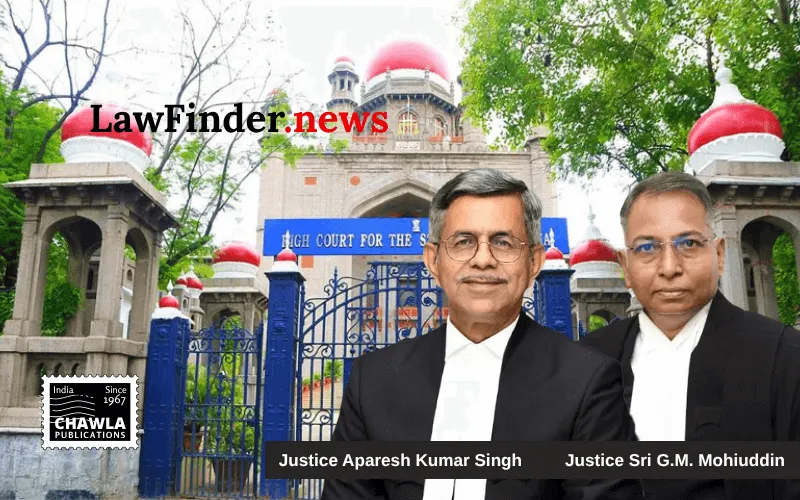
In a significant ruling, the Telangana High Court has upheld the rejection of a compassionate appointment claim by S. Sanjeev, whose father, a lineman with the Northern Power Distribution Company of Telangana Limited (TSNPDCL), went missing in 2012. The Division Bench, comprising Chief Justice Sri. Aparesh Kumar Singh and Justice Sri. G.M. Mohiuddin, affirmed the earlier decision of a single judge, emphasizing the specific conditions of the compassionate appointment scheme.
The case revolved around the claim of S. Sanjeev, who sought a job on compassionate grounds after his father, S. Sayanna, disappeared while still in service. Despite efforts to trace his whereabouts, Sayanna was declared untraceable by police. Sanjeev's application was rejected by the TSNPDCL based on the company's scheme, which stipulates that employees with less than seven years of service remaining before retirement are not eligible for compassionate appointments. At the time of his disappearance, Sayanna had only 4 years, 3 months, and 23 days left until his retirement.
The High Court's decision was grounded in the clear language of the compassionate appointment scheme, which distinctly categorizes cases of "death in harness" and "missing employees," each with specific conditions. The court emphasized that the exclusion clause is clear and unambiguous, and cannot be relaxed through liberal interpretation. The court further noted that the presumption of death under Section 108 of the Indian Evidence Act, which arises after a person is missing for over seven years, does not override the specific terms of the scheme.
The appellant's counsel argued that the scheme should be interpreted liberally, given its social welfare objective. However, the court dismissed this argument, reiterating that compassionate appointment is not a right but an exception to regular recruitment rules, and must strictly adhere to the scheme's terms.
The court also addressed allegations of arbitrariness and discrimination, finding no evidence that similarly situated individuals had been treated differently. It concluded that the classification within the scheme, based on remaining service years, was rational and not arbitrary.
Ultimately, the court dismissed the writ appeal, affirming the single judge's order and clarifying that this judgment does not preclude Sanjeev from pursuing other legal remedies for claiming his father's terminal benefits or pension.
Bottom line:-
Compassionate appointment - Rejection of claim for appointment on compassionate grounds due to non-fulfillment of scheme conditions - Exclusion clause for employees having less than seven years of service remaining before superannuation upheld - Presumption of death under Section 108 of the Indian Evidence Act, 1872, cannot override specific conditions of the scheme.
Statutory provision(s): Indian Evidence Act, 1872 Section 108, Constitution of India, 1950 Articles 14 and 16.