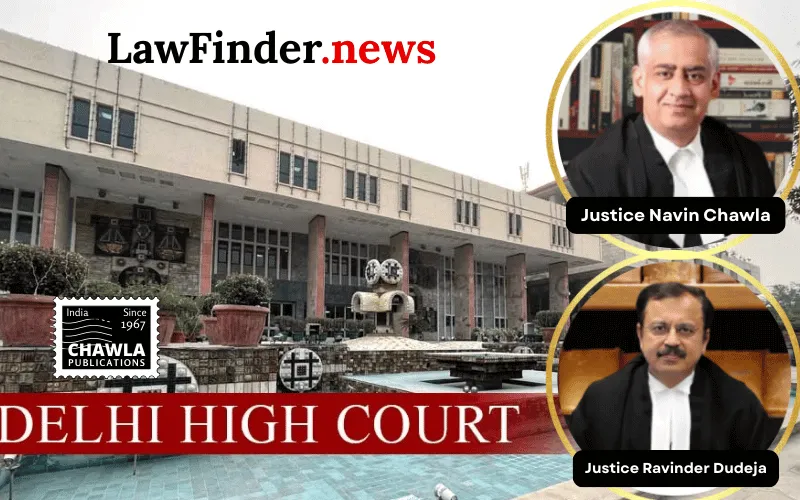
New Delhi, Mar 20 The Delhi High Court on Friday granted bail to two men accused in a UAPA case over an alleged conspiracy to undertake terrorist acts in the country, observing that they had already undergone "prolonged incarceration" of over four years.
A bench of Justices Navin Chawla and Ravinder Dudeja allowed the appeals by Haris Nisar Langoo and Zamin Adil Bhat, both arrested in October 2021 by the NIA, against a trial court order that refused them bail in 2023.
The bench said, considering the limited role of the appellants, their continued detention would not serve the ends of justice.
"We, therefore, are of the view that taking into consideration the allegations against the appellant(s), their continued detention may amount to a violation of their right under Article 21 of the Constitution of India. The appellant(s) have already undergone prolonged incarceration of around 4 years and 4 months, without any certainty of the trial concluding within a reasonable time," the court said.
The bail was granted with the condition of furnishing personal bail bonds of Rs 50,000 with two sureties of like amount.
In its 29-page judgement, the court noted that the appellants were allegedly part of social media groups where anti-national messages propagating terrorism were being shared, but there was no allegation of their being the creators of the groups or of sharing any objectionable material.
Although the material found on the digital devices of the appellants may be propagating anti-national activities, it cannot justify the continuation of their prolonged detention at the stage of trial, the bench said.
The court cited a Supreme Court ruling to emphasise the difference between "ideological alignment" and "operational participation" while deciding matters of bail in UAPA cases.
According to that ruling, the court said, sympathy for a cause, or even the possession of literature and digital content associated with a banned outfit, does not by itself constitute membership of such outfit or active participation in its terrorist activities.
The court also took into account that Langoo suffered from cervical spondylosis, which deteriorated during the period of his incarceration, and stated that an undertrial prisoner's health is a relevant consideration when assessing rights under Article 21 of the Constitution.
Prolonged pre-trial detention of a person whose alleged role is predominantly digital and non-violent in nature, and who is additionally suffering from an ailment, further tilts the balance in favour of conditional release, it said.
The court said the case and evidence against the appellants have to be tested in the trial.
It said the bail was subject to certain conditions, which had been "calibrated" to protect the legitimate interests of national security and the integrity of the trial process.
At the same time, it must also be ensured that the appellants were "not subjected to pre-trial detention that has effectively become punitive given the projected duration of trial and the limited role attributed to them in the charge sheet," the court said.
Besides ordering the surrender of their passports, the court also directed the appellants to neither join any WhatsApp group, nor any other social media platforms where anti-national material was uploaded, circulated, or propagated, nor share such content on any platform.
It also asked them to fully cooperate with the trial, periodically report to the local police station, furnish their residential address and not leave the country without permission.
In the instant matter, the FIR was registered by the NIA on October 10, 2021, under the Indian Penal Code and the Unlawful Activities (Prevention) Act [UAPA].
The FIR was filed at the instance of the central government to the agency to take up investigation allegedly after it was "reliably learnt that cadres of proscribed terrorist organizations are all active in Jammu and Kashmir and are being orchestrated from Pakistan and are conspiring both physically and in cyberspace and planning to undertake violent terrorists act in J & K and major cities in India, including New Delhi."
In their appeals, Langoo and Bhat, both in their 20s, said they worked as part-time delivery agents at a local restaurant in Srinagar, and no incriminating material was recovered from them to suggest they were part of any of the proscribed outfits or were actively propagating their ideology.
The prosecution alleged that Bhat was a highly radicalised individual who actively propagated videos, images, and audio material related to the Islamic State and Islamic State Jammu and Kashmir among his contacts to motivate and radicalise them to join jihad.
Langoo, it was alleged, was closely associated with Bhat and other accused, and acted as a facilitator for the dissemination of radical content through digital platforms.
The petitions said the FIR in the present case was vague and did not name the appellants, and the lower court order of March 3, 2023, refusing to grant them bail should be set aside.
In April 2022, the NIA filed a chargesheet in the case under sections 120B, 121A, 122, 123 of the IPC and sections 18, 18A, 18B, 20, 38 and 39 of the UAPA, which included the offences of waging war against the country, conspiracy, and terrorist activities.
Haris Nisar Langoo v. National Investigation Agency, (Delhi)(DB) : Law Finder Doc Id # 2869442