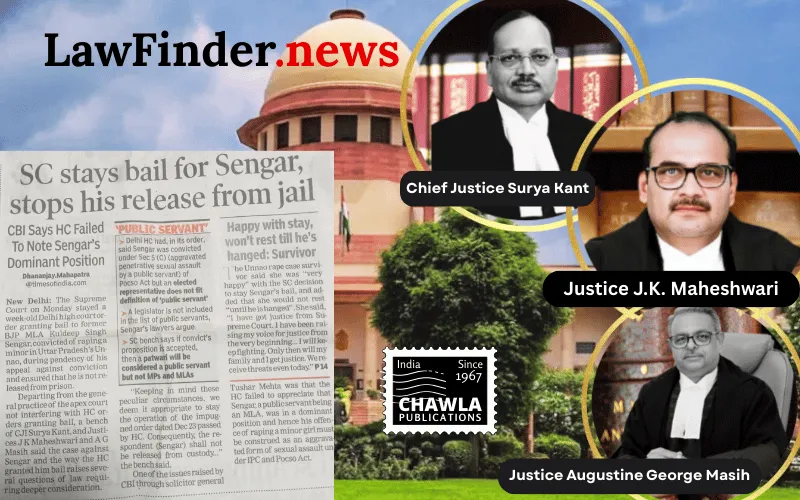
New Delhi, Dec 29 The Supreme Court on Monday stayed the Delhi High Court order suspending the life sentence of expelled BJP leader Kuldeep Singh Sengar in the 2017 Unnao rape case and said he shall not be released from custody.
A vacation bench comprising Chief Justice Surya Kant and Justices J K Maheshwari and Augustine George Masih, which was hearing the CBI's plea challenging the high court order, said that substantial questions of law have arisen in the matter that require consideration.
The apex court also issued notice to Sengar seeking his response within four weeks on the CBI's plea.
The bench said it was conscious of the fact that ordinarily when a convict or an under-trial was released on bail pursuant to an order passed by a trial court or the high court, such order shall not be stayed by it without hearing such person.
It noted that Sengar was also convicted and sentenced in a separate case and was still in custody in that matter.
"In the peculiar circumstances of the case, we stay the operation of the impugned order dated December 23, 2025, passed by the high court. Consequently, the respondent (Sengar) shall not be released from custody pursuant to the said order," the bench said.
The top court said various substantial questions of law have arisen for its consideration in the matter.
Solicitor General Tushar Mehta, appearing for the CBI, urged the bench to stay the high court order, saying it was a "horrific rape" of a minor child.
"This is an occasion where I would really urge your lordships' conscience to stay this order. We are answerable to the child who was (aged) 15 years and 10 months," the top law officer said.
He also referred to the aspect of 'public servant' and said Sengar was then a very powerful MLA of the area at the relevant time.
The Delhi High Court had, in its December 23 order, said that Sengar has been convicted under Section 5 (C) (aggravated penetrative sexual assault by a public servant) of the POCSO Act but an elected representative does not fit the definition of a "public servant" under Section 21 of the IPC.
"Is it your argument that the concept of being a 'public servant' is completely alien and irrelevant when the victim is a minor?" the CJI asked.
Responding in the affirmative, Mehta said 'public servant' is not defined in the Protection of Children from Sexual Offences (POCSO) Act.
He also referred to Section 42A of the POCSO Act which says that provisions of this law shall be in addition to and not in derogation of the provisions of any other law for the time being in force and, in case of any inconsistency, the provisions of POCSO shall have overriding effect.
Senior advocate N Hariharan, along with other lawyers, appeared for Sengar and opposed the CBI's plea seeking a stay on the high court order.
"We are only saying that the matter requires consideration," the bench said, adding that arguments advanced by Sengar's lawyers also have weight and require in-depth consideration.
The top court observed it was only worried that a constable or a 'patwari' will be a 'public servant' for the purpose of committing such an offence but a member of parliament or an elected member of a state legislative assembly may be exempted if this interpretation was construed to be correct.
"Very frankly, these judges are one of the finest we have," the bench observed, adding, "There is very in-depth analytical analysis made... But at the same time, we are all prone to commit errors".
The bench said the victim has a statutory right to file a separate special leave petition (SLP) against the high court order.
Hariharan raised the issue of high court judges being targeted for the order, saying that people should refrain from making statements or allegations against the judges. "They are doing that on national television," he said.
The bench said, "We understand it. We are not sitting in ivory towers. We understand that people are trying to take political advantage and there are people who are trying to take advantage".
Hariharan said there is a video circulating levelling allegations against the judges who had passed the order and this was a cause of concern.
The bench observed that such people are simply forgetting that Sengar was convicted by the judiciary only.
Later, asked about the issue of allegations being made against the judges, Mehta said both the high court judges are "brilliant with unimpeachable integrity" and any attempt to malign them must be strongly condemned.
He said there are always some elements that attempt to browbeat honest judges and such devious forces must not be encouraged.
The high court had suspended the jail term of Sengar, who was serving life imprisonment in the Unnao rape case, till the pendency of his appeal, saying he had already served seven years and five months in prison.
The high court order has sparked criticism from a section and there have been protests by the victim, her family and activists.
Sengar had challenged a December 2019 trial court verdict in the case. He had, however, remained in jail since he was also serving 10 years' imprisonment in the custodial death case of the victim's father and has not been granted bail in that case.
The rape case and other connected cases were transferred to Delhi from a trial court in Uttar Pradesh on the directions of the Supreme Court on August 1, 2019.
Sengar's appeal against his conviction in the case of the custodial death of the survivor's father is also pending, where he has sought suspension of sentence on the ground that he has already spent a substantial time in jail.
In its plea filed in the apex court, the CBI referred to its verdict in the L K Advani case in which it held that anyone who holds public office, like MPs or MLAs, would be deemed a 'public servant'.
It contended that the high court erred by declaring that Sengar, an MLA when the offence was committed, was not a 'public servant' to be prosecuted under POCSO and granted him bail.
Central Bureau of Investigation v. Kuldeep Singh Sengar, (SC) : Law Finder Doc Id # 2829205