Supreme Court overturns high court's erroneous release order in Habeas Corpus Petition. The Court reinforces jurisdictional boundaries, emphasizes lawful custody in criminal proceedings
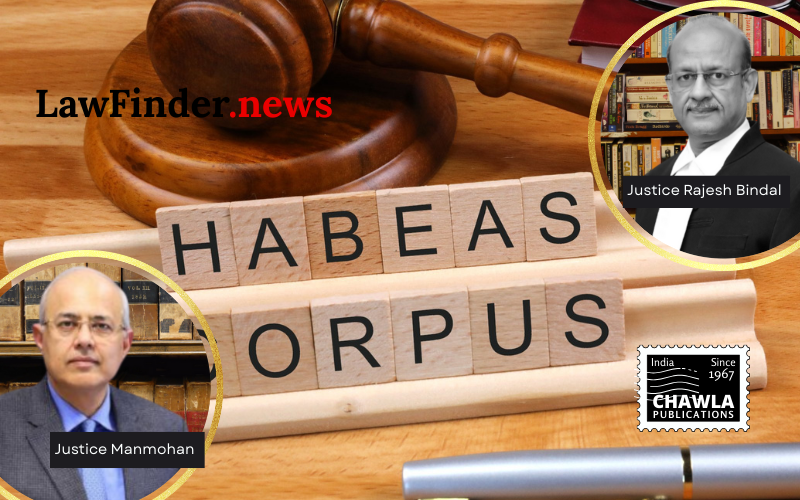
The Supreme Court of India has set aside an order passed by the High Court of Madhya Pradesh, which had erroneously exercised its jurisdiction to release an accused in a criminal case through a writ of habeas corpus. The Supreme Court, comprising Justices Rajesh Bindal and Manmohan, delivered the judgment on November 3, 2025, in the case of State of Madhya Pradesh v. Kusum Sahu, scrutinizing the High Court’s overreach in a matter of criminal custody.
The case involved Jibrakhan Lal Sahu, who was arrested on December 12, 2023, in connection with FIR/Crime No.157 of 2021 for offenses under Sections 420 and 409 of the Indian Penal Code, 1860. Despite the rejection of four consecutive bail applications by the High Court, a writ petition was filed by his daughter, Kusum Sahu, claiming unlawful detention and seeking his release.
The High Court, in a controversial decision dated October 3, 2024, directed the release of Jibrakhan Lal Sahu, citing financial constraints and mental agony of the parties involved. This order was challenged by the State, arguing that the custody was lawful as all bail applications had been duly considered and rejected.
The Supreme Court criticized the High Court’s decision, stating that custody in a criminal case cannot be deemed unlawful solely based on rejected bail applications. The apex court emphasized that habeas corpus jurisdiction cannot be misused to bypass established legal procedures, especially when avenues for challenging bail rejections are available through higher judicial forums.
The Supreme Court’s decision underscores the importance of adhering to the prescribed legal processes and maintaining the sanctity of judicial jurisdiction. It also highlighted that any grievance regarding bail rejections should be pursued through appropriate legal channels rather than through habeas corpus petitions, which are designed to address unlawful detentions.
In conclusion, the Supreme Court allowed the appeal, reaffirming the lawful custody of Jibrakhan Lal Sahu and setting aside the High Court's order. It also clarified that any future bail applications by the accused should be evaluated on their merits by the concerned court.
Bottom Line:
Habeas corpus jurisdiction cannot be exercised to release an accused whose bail applications were rejected, as custody in a criminal case registered against him cannot be held to be unlawful.
Statutory provision(s): Article 226 of the Constitution of India, 1950; Sections 420, 409 of the Indian Penal Code, 1860; Sections 439, 482 of the Criminal Procedure Code, 1973.
State of Madhya Pradesh v. Kusum Sahu, (SC) : Law Finder Doc id # 2809081