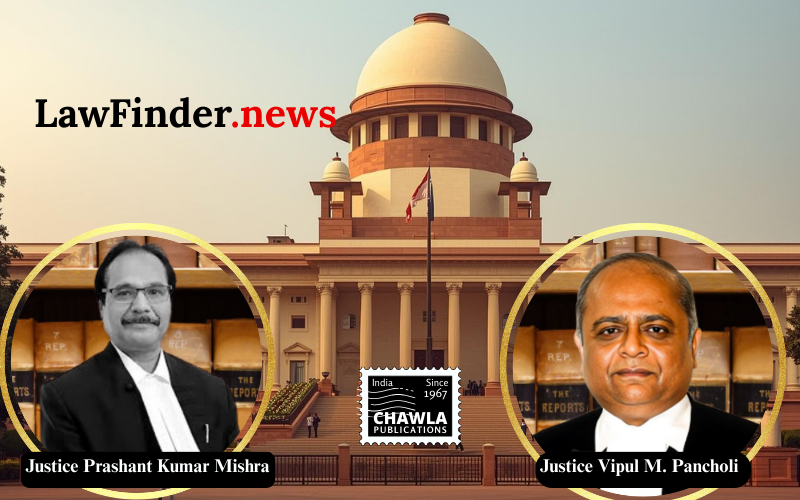
Supreme Court Upholds Dismissal of Appeal in Property Succession Case, Credibility of Sole Attesting Witness in Will Disputed, Appeal Dismissed for Lack of Authority to Continue
The Supreme Court of India has upheld the dismissal of a civil appeal in the case of "Kamala Bai v. Kanna Rao " concerning the succession of property and the validity of a contested will. The bench, comprising Justices Prashant Kumar Mishra and Vipul M. Pancholi, delivered the judgment on December 4, 2025, affirming the earlier decisions of the lower courts.
The case originated from a suit filed by Kamala Bai against her son, Ballera Kanna Rao, seeking a declaration of title over certain property and recovery of past rent. After the trial court partially decreed in favor of the plaintiff, the original plaintiff filed an appeal. However, during the pendency of the appeal, the original plaintiff passed away, prompting the appellant, Kamala Bai, to seek substitution as the legal heir based on a will dated March 11, 1999.
The crux of the dispute centered around the credibility of the sole attesting witness, PW-5, whose testimony was deemed insufficient to prove the will's genuineness. The Supreme Court noted that the witness admitted his chief affidavit was not prepared under his instructions and confessed ignorance of its contents, casting doubt on the will's authenticity.
Relying on Sections 63(c) of the Indian Succession Act, 1925, and Section 68 of the Indian Evidence Act, 1872, the court emphasized the necessity of credible attesting witnesses in proving a will. The court found that without reliable testimony, the appellant lacked the authority to continue the appeal as the legal heir.
The judgment underscores the critical role of credible witness testimony in succession disputes, particularly when the validity of a will is in question. The court's decision leaves the trial court's partial decree intact and does not affect the natural line of succession following the original plaintiff's demise.
Bottom Line:
Will - Attesting witness' credibility crucial - If the sole attesting witness admits that the chief affidavit was not prepared under his instructions and he does not know the contents of the affidavit or the will, the evidentiary value of his statement is significantly diminished.
Statutory provisions: Indian Succession Act, 1925 Section 63(c), Indian Evidence Act, 1872 Section 68, Civil Procedure Code, 1908 Order 22, Rule 3.


