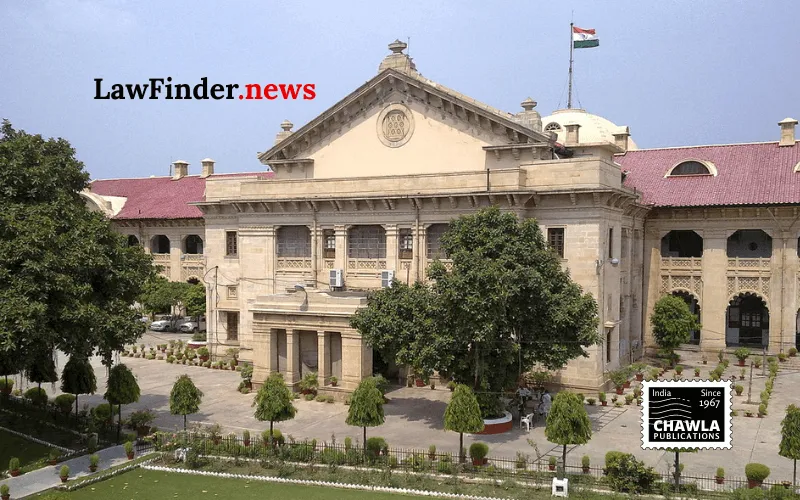
Prayagraj (UP), Jul 3 The Allahabad High Court has observed that the Places of Worship (Special Provisions) Act, 1991 prohibits only the 'conversion' of the religious character of a place of worship from one religious denomination to another, but it does not bar the state from acquiring such properties for secular and public purposes.
The court dismissed a writ petition seeking to halt the widening and beautification of the Dalmandi area in Varanasi, a project undertaken as a part of the Uttar Pradesh government's Shri Kashi Vishwanath Dham corridor development.
The petitioners, who are six tenants and shopkeepers operating in the Dalmandi area, moved the high court seeking a writ of mandamus to prevent their dispossession from the area. They also sought protection for six ancient mosques in the area that were proposed for takeover and demolition as part of the project.
Dismissing the writ petition filed by Syed Rashid Ali and six other tenants, a division bench comprising Justices J J Munir and Arun Kumar observed, "The Act of 1991 prohibits the conversion of place of worship of one religious denomination into another. It does not derogate from the state's authority to acquire any place of religious worship for a secular and public purpose like development of a road or augmentation of infrastructure or any similar activity."
The Dalmandi area is located around 800 metres from the Kashi Vishwanath temple and the six ancient mosques proposed for demolition by the administration are Anjuman Intezamia Masjid, Masjid Rangile Shah, Masjid Ali Raza Khan, Masjid Karimullah Baig, Masjid Nisaran and Masjid Sangamarmar.
The petitioners submitted that no public purpose, which the respondents say is involved, would be served by depriving thousands of citizens of their right to livelihood and shelter as well as their right to worship by demolishing the six ancient mosques located in the area.
The petitioners submitted that these mosques, having existed since before August 15, 1947, were protected under the Places of Worship (Special Provisions) Act, 1991 and their demolition would violate the 1991 Act.
The petitioners also submitted that the proposed acquisition for the expansion of the project route was arbitrary, illegal and a violation of their fundamental rights, and that it was designed to "target a particular community".
The state, on the other hand, argued that the 1991 Act does not prohibit the government from acquiring worship land for larger public purposes. The government has the sovereign power to acquire any property, including religious property for a public purpose, such as building roads, highways or public infrastructure.
In its 32-page judgment delivered on Thursday, the court observed that the petitioners being mere tenants and not owners of the properties in question had limited standing to challenge the acquisition process.
"We would think that the petitioners are more or less here in order to protect their business and source of livelihood rather than proprietary rights," it noted.
The court further noted that the title holders had not come forward to challenge the project emphasising that in matters of land acquisition under the 2013 Act, it is primarily the title holder who has locus to object, negotiate a sale or suffer an acquisition.
The court also was not persuaded that being Muslims, the petitioners themselves have a right to protect the mosques in question. On this, the court said, "The mosques are admittedly registered Waqf with their own Mutawalli in each case. No doubt, members of the Muslim community may come forward in certain cases, but essentially it is the Mutawalli and the Waqf Board who have to protect such properties."
The court also relied upon the landmark Supreme Court decision in Dr M Ismail Faruqui and others vs Union of India, in which it was held that a mosque is not an essential part of the practice of the religion of Islam and namaz (prayer) by Muslims can be offered anywhere, even in open and hence, its acquisition is not prohibited by the provisions in the Constitution of India.