Supreme Court Restores Specific Performance in Landmark Property Sale Case, The Apex Court Overturns High Court's Decision, Upholding Enforceability of Agreement to Sell Despite Earnest Money Refund Clause
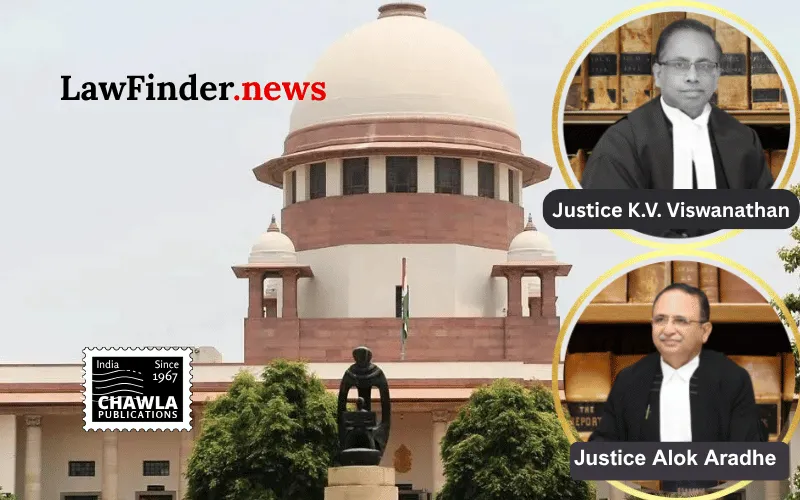
In a significant ruling, the Supreme Court of India has restored the judgment of the First Appellate Court, thereby granting specific performance in a property sale agreement dispute between Jaspal Singh and Ashwani Kumar. The judgment, delivered by a bench comprising Justices K.V. Viswanathan and Alok Aradhe, overturns the Punjab & Haryana High Court's decision which had set aside the decree of specific performance citing the absence of an express clause for enforcement through court.
The dispute originated from an agreement dated June 22, 2003, whereby Ashwani Kumar agreed to sell his half share of land situated in Jalandhar, Punjab, to Jaspal Singh for Rs. 12.5 lakh. Despite paying Rs. 9 lakh as earnest money, Jaspal Singh had to file a suit for specific performance when the sale deed was not executed by the stipulated date. The agreement also contained a clause for refund of the earnest money in case of non-execution, which the High Court interpreted as barring specific performance.
However, the Supreme Court clarified that such a refund clause does not preclude the remedy of specific performance unless it explicitly substitutes performance with payment. The Court emphasized that Section 23 of the Specific Relief Act, 1963 allows for specific enforcement of agreements even when a sum is named for breach, unless it is intended as an alternative to performance.
The judgment meticulously analyzed the scope of second appeals under Section 100 of the Civil Procedure Code, reiterating that High Courts cannot interfere with concurrent findings of fact unless vitiated by perversity. The Supreme Court noted that the High Court had transgressed its jurisdiction by reassessing facts without finding any perversity in the Trial and Appellate Courts' judgments.
Furthermore, the Apex Court dismissed the fraud defense presented by Ashwani Kumar, highlighting that the concurrent findings established the genuineness of the transaction and the appellant’s readiness and willingness to perform his obligations. The Court also refuted the High Court’s inference that the transaction was not genuine due to the lack of a clause for enforcement through court and the repeated extensions of the sale deed execution date.
In conclusion, the Supreme Court restored the First Appellate Court's decree, granting specific performance to Jaspal Singh and dismissing the High Court's judgment as erroneous. The ruling underscores the judiciary's commitment to uphold contractual obligations and provides clarity on the enforceability of agreements to sell property even in the presence of an earnest money refund clause.
Bottom Line:
Specific performance of an agreement to sell cannot be denied merely because the agreement contains a clause for refund of earnest money in case the sale deed could not be executed, as the clause does not bar the remedy of specific performance under the Specific Relief Act, 1963.
Statutory provision(s): Specific Relief Act, 1963 Section 23, Civil Procedure Code, 1908 Section 100
Jaspal Singh v. Ashwani Kumar, (SC) : Law Finder Doc id # 2940747