High Court raises doubts over witness credibility and identification process, granting bail with stringent conditions during appeal pendency.
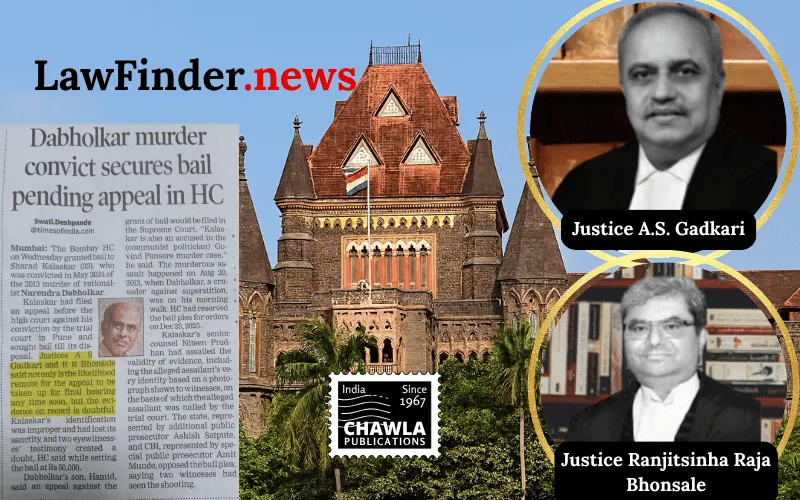
In a significant development in the high-profile murder case of rationalist Dr. Narendra Dabholkar, the Bombay High Court has suspended the sentence of Sharad Bhausaheb Kalaskar, one of the accused, and granted him bail during the pendency of his appeal. The division bench comprising Justices A.S. Gadkari and Ranjitsinha Raja Bhonsale expressed doubts over the identification process and the credibility of eyewitnesses, leading to the decision.
Dr. Dabholkar, a noted rationalist and social worker, was shot dead on 20th August 2013, in Pune. The case, which has drawn significant public attention, was initially investigated by the local police before being transferred to the Central Bureau of Investigation (CBI).
Kalaskar, who was convicted under Section 302 read with Section 34 of the Indian Penal Code and Section 3(25) of the Indian Arms Act, had been sentenced to life imprisonment by the Additional Sessions Judge, Pune. However, doubts were raised regarding the identification of Kalaskar, which was primarily based on photographs shown to witnesses while in custody, without conducting a Test Identification Parade.
The court noted that the credibility of the eyewitnesses was questionable, as they prioritized daily chores over immediately reporting the incident. The High Court observed that the identification process, conducted through photographs while Kalaskar was in custody, lacked sanctity, further weakening the prosecution's case.
Kalaskar's counsel argued that the identification was unreliable, and the prosecution failed to recover the weapon used in the crime. The court took into account that Kalaskar had already been in custody for more than seven and a half years, and with the appeal's early disposal appearing unlikely, the court found it prudent to grant bail.
The bail comes with stringent conditions, including periodic reporting to the Deccan Police Station in Pune. The court emphasized that any failure to comply with the conditions could lead to a revocation of bail.
The High Court's decision marks a pivotal moment in the case, underscoring the importance of credible evidence and procedural integrity in criminal trials. The order has been implemented despite requests from the intervener to stay the decision, enabling further legal scrutiny by the Supreme Court.
Bottom Line:
Application for suspension of sentence and bail during the pendency of appeal - Identification of accused solely based on photographs shown to witnesses while in custody lacks sanctity - Conduct of eyewitnesses raises doubt regarding their credibility - Substantive sentence suspended, and bail granted.
Statutory provision(s): Section 389(1) of the Criminal Procedure Code, 1973, Section 302 read with Section 34 of the Indian Penal Code, 1860, Section 3(25) of the Indian Arms Act, Section 9 of the Indian Evidence Act, 1872
Sharad Bhausaheb Kalaskar v. State of Maharashtra, (Bombay)(DB) : Law Finder Doc id # 2890843