Husband's Attempt for Second Divorce Suit Dismissed; Court Affirms Finality of Previous Judgment
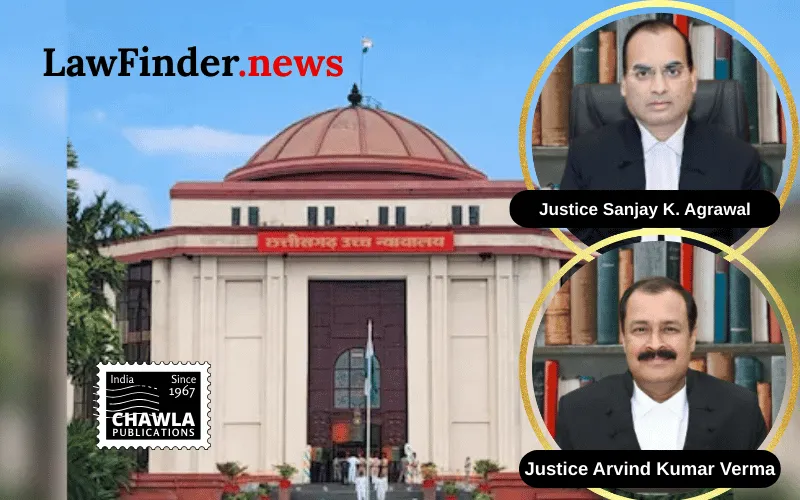
In a significant judgment, the Chhattisgarh High Court has reaffirmed the applicability of the principle of res judicata to matrimonial disputes under the Hindu Marriage Act, 1955. The Division Bench, comprising Justices Sanjay K. Agrawal and Arvind Kumar Verma, dismissed an appeal filed by Udayram Basant, who sought the dissolution of his marriage on grounds of cruelty and desertion. The Court held that the appellant's second suit was barred by res judicata, having been based on the same cause of action as a previously adjudicated case.
The legal proceedings were initiated by Udayram Basant against his estranged wife, Smt. Jyoti, with whom he has been living separately since September 2001. Basant's initial attempt to dissolve the marriage was dismissed by the trial court in 2004, a decision upheld on appeal in 2007. Despite a decade-long gap, Basant filed another suit in 2014, arguing that the marriage had irretrievably broken down.
However, Smt. Jyoti contested the suit, asserting that it was barred by res judicata, a legal doctrine preventing the relitigation of issues already settled by final judgment. The Family Court agreed, noting that the cause of action from the previous suit remained unchanged, thereby rendering the second suit untenable. This decision was subsequently challenged in the High Court.
In its judgment dated January 27, 2026, the High Court meticulously examined the application of res judicata within matrimonial contexts, referencing Section 11 of the Code of Civil Procedure, 1908. The Court emphasized that the principle aims to prevent repeated litigation over the same issue, thereby upholding judicial efficiency and certainty.
The Court further clarified that under Section 21 of the Hindu Marriage Act, 1955, the provisions of the Civil Procedure Code are applicable to matrimonial proceedings unless inconsistent with the Act itself. Citing precedents such as Guda Vijayalakshmi v. Guda Ramachandra Sekhara Sastry, the judges reinforced that res judicata is indeed applicable to proceedings under the Hindu Marriage Act.
Additionally, the Court highlighted the procedural latitude granted to Family Courts under the Family Courts Act, 1984, which allows reliance on prior litigation documents without strict adherence to evidentiary rules. This flexibility supports the application of res judicata by enabling Family Courts to consider previous judgments effectively.
On examining the merits, the High Court found no substantive evidence to support Basant's claims of cruelty and desertion. It concluded that the appellant failed to establish new grounds or a distinct cause of action that could warrant revisiting the matter. Consequently, the appeal was dismissed, affirming the trial court's decision.
This judgment underscores the judiciary's commitment to upholding legal doctrines that ensure finality and consistency in judicial outcomes. It serves as a reminder of the binding nature of previous judgments, particularly in matrimonial disputes where emotional and legal complexities often intertwine.
Bottom Line:
Family Law - Applicability of res judicata to matrimonial disputes under Section 13 of the Hindu Marriage Act, 1955 - Second suit for dissolution of marriage based on same cause of action as the first suit is barred by res judicata.
Statutory provision(s): Section 11 of the Code of Civil Procedure, 1908; Section 13(1)(ia) & (ib) of the Hindu Marriage Act, 1955; Section 21 of the Hindu Marriage Act, 1955; Section 10 of the Family Courts Act, 1984.
Udayram Basant v. Smt. Jyoti, (Chhattisgarh)(DB) : Law Finder Doc id # 2849018