Petitioner's Challenge Rejected; Respondent's Appointment as Assistant Professor Confirmed
Gwalior, April 2, 2026 - In a significant ruling, the Madhya Pradesh High Court dismissed the petition filed by Smt. Sunita Yadav challenging the appointment of respondent no. 3, an OBC (Other Backward Classes) candidate, to the post of Assistant Professor (Law) at a government college. The court's decision centered around the determination of the creamy layer status, a crucial factor in deciding eligibility for reservation benefits.
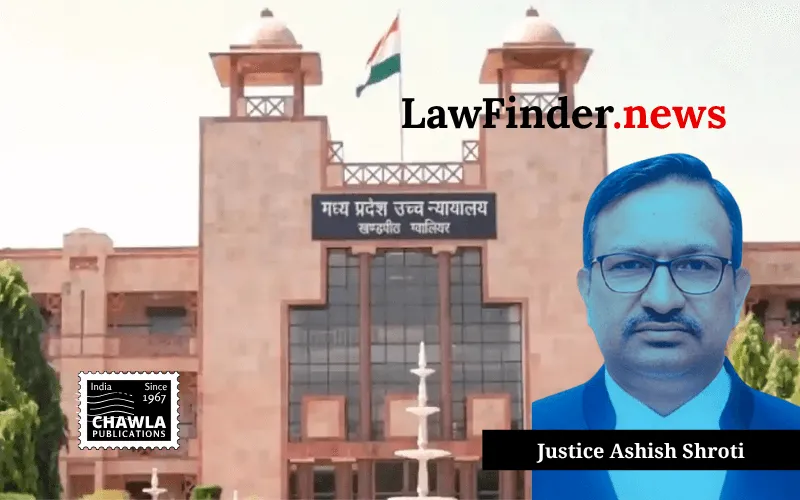
The case, presided over by Justice Ashish Shroti, revolved around the criteria for classifying a candidate under the creamy layer category within the OBC reservation framework. The petitioner contended that respondent no. 3 should be classified as belonging to the creamy layer, thus disqualifying her from availing the OBC reservation benefits. The argument was primarily based on the income of respondent no. 3's husband, who is a Civil Judge Class-I (a Class-II post), and her own income as a guest faculty.
Justice Shroti clarified that the determination of the creamy layer status should be based solely on the income and social status of the candidate's parents, not the candidate's own income or that of the spouse unless the spouse holds a Class-I post. The court emphasized that the guidelines and circulars issued by the government specifically state that the income of the candidate's husband is irrelevant unless he is a Class-I officer. In this instance, the respondent's husband is a Class-II officer, and therefore, his income does not affect the creamy layer classification.
The court cited several Supreme Court judgments, including the landmark Indra Sawhney case, which established the principle that reservation benefits should not be appropriated by socially advanced sections within the OBCs. The judgment reinforced the objective of excluding the creamy layer, ensuring that reservation benefits reach the truly deserving candidates among the backward classes.
The petitioner also argued that the family's combined income exceeded the threshold for the creamy layer classification, referencing a corrigendum by the Madhya Pradesh Public Service Commission setting the limit at Rs. 8 lakh. However, the court dismissed this argument, reiterating that the income from salary or agricultural land is not considered for determining creamy layer status.
The court upheld the appointment of respondent no. 3, confirming that her parents' income did not place her in the creamy layer, and her caste certificate was duly verified by competent authorities. As a result, the petitioner's challenge was deemed unfounded, and the petition was dismissed.
This ruling has implications for the interpretation and application of creamy layer criteria in OBC reservations, affirming the importance of adhering to established guidelines and judicial precedents. It underscores the need for a clear understanding of the criteria for exclusion under the creamy layer provision to ensure that reservation benefits are allocated appropriately.
Bottom Line:
Determination of creamy layer status for OBC candidates should be based on the income and social status of parents, not the candidate's own income or spouse's income unless the spouse holds a Class-I post.
Statutory provision(s): Article 226 of the Constitution of India