Court Upholds Tamil Nadu Pension and Conduct Rules, Dismissing Claim for Family Pension by Second Wife
In a significant ruling, the Madras High Court has reaffirmed the principles laid out under the Tamil Nadu Government Servants Conduct Rules, 1973, and the Tamil Nadu Pension Rules, 1978, by declaring a second marriage contracted during the lifetime of a first spouse as void, subsequently denying family pension benefits to the second wife. This decision came in the case titled "Accountant General Accounts and Entitlements v. M. Radhakrishnan," where the court was asked to consider the entitlement of a second wife to pension benefits following the death of the first wife.
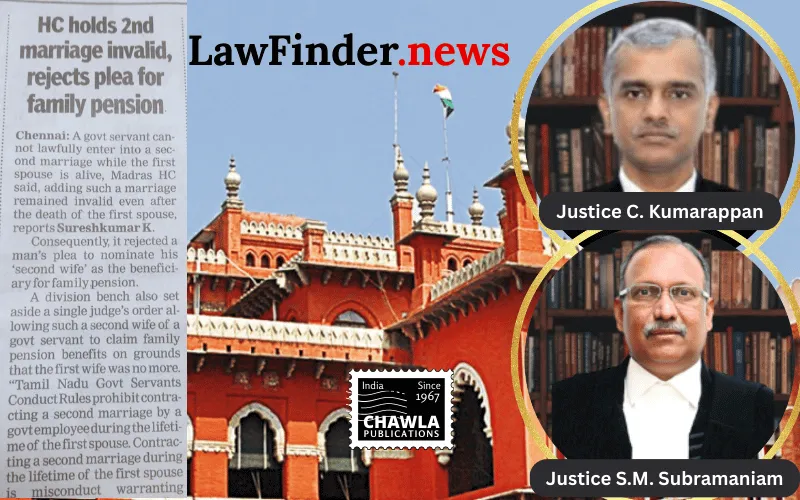
The case was brought forth by the Accountant General of Tamil Nadu, who challenged a writ order that had earlier allowed the inclusion of the second wife, Mrs. R. Revathy, in the Pension Payment Order of Mr. M. Radhakrishnan, a retired Block Development Officer. The court, presided over by Justices S.M. Subramaniam and C. Kumarappan, found that Mr. Radhakrishnan's second marriage, solemnized on May 27, 1992, while his first wife was still alive, was null and void under the applicable rules and thus did not confer any pension rights to the second wife.
The court reiterated that, under Rule 19 of the Tamil Nadu Government Servants Conduct Rules, a government servant is prohibited from contracting a second marriage during the lifetime of a first spouse unless permitted by personal law. Moreover, Rule 49 of the Tamil Nadu Pension Rules stipulates that family pension benefits are only available to legally wedded spouses. These rules are designed to uphold the sanctity of legally recognized marriages and ensure that pension benefits are distributed in accordance with statutory provisions.
The bench cited previous judgments, including those by the Supreme Court, to support its decision. In particular, the court referred to the case of "Raj kumari v. Krishna," where it was held that pension benefits are intended for legally wedded spouses and that a second marriage, contracted without the dissolution of the first, is not recognized for pension entitlement.
Despite the death of Mr. Radhakrishnan's first wife in 2020, the court concluded that this did not alter the void status of the second marriage, nor did it create an entitlement to family pension for Mrs. Revathy. The court emphasized that the policies and rules concerning pension are welfare measures designed to support legitimate beneficiaries in line with legal and ethical standards.
The ruling underscores the strict adherence to conduct and pension rules applicable to government servants, reinforcing the legal framework that governs marital relations and entitlements within the public service sector. The court's decision to set aside the previous writ order and deny the claim of the second wife reflects a commitment to uphold statutory provisions and ensure equitable administration of pension benefits.
Bottom Line:
Second marriage contracted during the lifetime of the first spouse is void under Tamil Nadu Government Servants Conduct Rules, 1973, and the second wife is not entitled to family pension under Tamil Nadu Pension Rules, 1978.
Statutory provision(s): Tamil Nadu Pension Rules, 1978; Tamil Nadu Government Servants Conduct Rules, 1973