Supreme Court Upholds Right to Education Act Mandate for Neighbourhood Schools, Schools Required to Admit Students from Weaker Sections Without Delay, Ensuring Social Integration and Equality
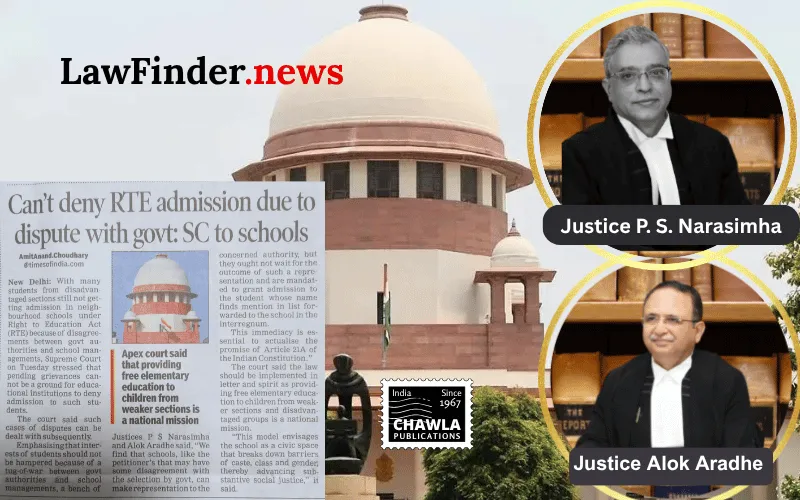
In a significant ruling, the Supreme Court of India has reinforced the obligation of neighbourhood schools to admit students from weaker and disadvantaged sections as mandated by the Right of Children to Free and Compulsory Education Act, 2009 (RTE Act, 2009). The judgment, delivered by Justices Pamidighantam Sri Narasimha and Alok Aradhe, upheld the decision of the High Court directing Lucknow Public School, Eldico, to admit a student forwarded by the State Government of Uttar Pradesh under the RTE framework.
The court emphasized that neighbourhood schools are constitutionally and statutorily obligated to admit at least 25% of their entry-level class strength from weaker sections and disadvantaged groups. This mandate, under Section 12(1)(c) of the RTE Act, aims to promote equality and social integration during the formative years of children.
The case arose when a student, selected for admission into the pre-primary class of the petitioner school as per the UP RTE Rules, 2011, was denied entry. The school cited uncertainty regarding the student’s eligibility, leading to a writ petition. The High Court ruled that schools have no authority to contest the State Government's selection process and must admit students without delay.
The Supreme Court reiterated that the right to education, a fundamental right under Article 21A of the Constitution, would remain an empty promise without the effective implementation of the RTE Act. The court underscored the judiciary's role in ensuring expeditious and effective judicial remedies for any denial of admission under the Act.
The judgment also highlighted the broader social objectives of the RTE Act, which seeks to transform societal structures by integrating children from diverse backgrounds in common educational settings. By enforcing these provisions, the court aims to advance substantive social justice and ensure equality of status and dignity for all children.
The Supreme Court dismissed the Special Leave Petition filed by Lucknow Public School, reinforcing the High Court's directive for immediate admission of the student. The decision underscores the judiciary's commitment to ensuring that the constitutional promise of education is realized through inclusive and equitable educational practices.
Statutory provision(s): Right of Children to Free and Compulsory Education Act, 2009 Section 12(1)(c), Constitution of India, 1950 Article 21A
Lucknow Public School, Eldico v. State of Uttar Pradesh, (SC) : Law Finder Doc id # 2889985