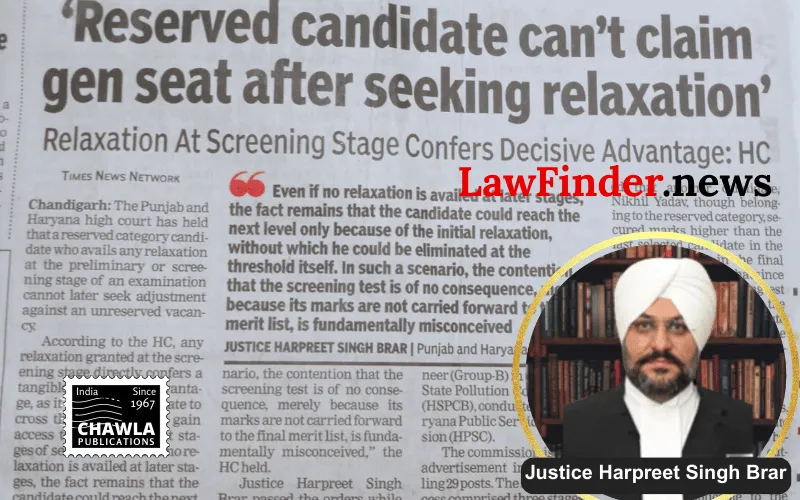
Court Denies Migration of Reserved Category Candidate to General Vacancy After Availing Relaxation
In a significant ruling, the Punjab and Haryana High Court has reaffirmed the principle that reserved category candidates who avail any form of relaxation during the recruitment process cannot subsequently claim allocation against unreserved vacancies. The decision was made in the case of Kartik Saini v. State of Haryana, where the petitioner challenged the final results of a recruitment process conducted by the Haryana Public Service Commission for the post of Assistant Environmental Engineer in the Haryana State Pollution Control Board.
Justice Harpreet Singh Brar presided over the case, which questioned whether a candidate from a reserved category, who had taken advantage of relaxed standards at the screening stage, could be considered for a general category position based on subsequent performance. The petitioner argued that a fellow candidate, Nikhil Yadav, should be migrated to the general category due to his higher merit score, which would have secured the petitioner’s selection in the BC-B category.
The court, however, held that the initial relaxation availed by Nikhil Yadav during the screening test stage, where he did not meet the general category cut-off, rendered him ineligible for migration to the general category. The decision was supported by the Supreme Court’s judgment in Union of India v. G. Kiran, which emphasized that any relaxation at any stage disqualifies a candidate from being considered under unreserved vacancies.
The court underscored that the screening test serves as a critical filtering mechanism, and any relaxation at this stage offers a decisive advantage. Thus, a candidate who benefits from such relaxation must be considered only within their reserved category. The ruling further reinforced that advertisement conditions, like those in the present recruitment process, have the force of law and bind the parties involved.
Moreover, the court highlighted that a candidate's participation in the selection process without objection precludes them from challenging the process post-failure. It reiterated that while selection guarantees the right to be considered, it does not confer a right to appointment.
This judgment underscores the importance of adhering to established reservation norms and serves as a precedent for future cases involving similar issues of candidate migration between reserved and unreserved categories.
Bottom Line:
Reserved category candidate availing relaxation at any stage of the selection process, including the preliminary/screening stage, cannot claim allocation against unreserved vacancies. Advertisement conditions governing selection have the force of law and bind the parties.
Statutory provision(s): Articles 226/227 of the Constitution of India
Kartik Saini v. State of Haryana, (Punjab And Haryana) : Law Finder Doc id # 2857518