Court Sets Aside Castigating Remarks Against Public Servant Due to Lack of Opportunity for Defense
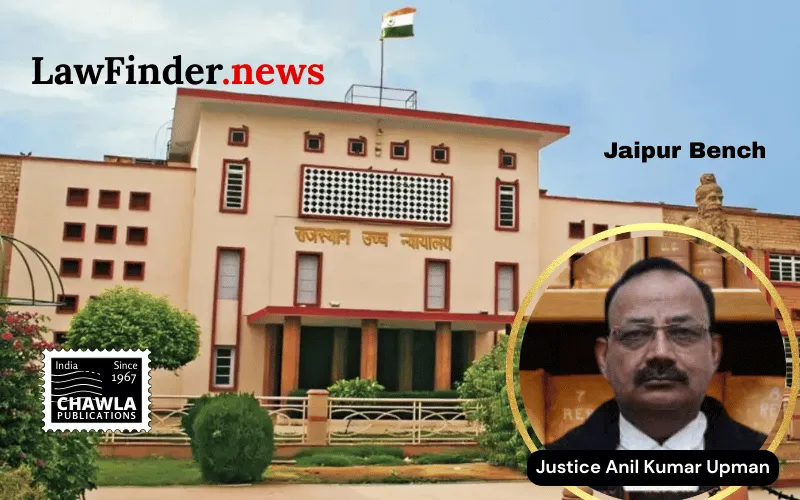
In a landmark decision, the Rajasthan High Court, Jaipur Bench, delivered a significant ruling on December 15, 2025, reinforcing the principles of natural justice. The court, presided by Justice Anil Kumar Upman, addressed the appeal by Vimal Singh, a public servant who faced adverse remarks in a previous judgment without being given an opportunity to defend himself.
The case originated from the judgment by the Special Judge, NDPS Cases, Jhalawar, in Sessions Case No. 63/2018, where Vimal Singh, then serving as Additional Superintendent of Police in Jhalawar, was accused of serious irregularities in his official duties. The judgment had directed the initiation of disciplinary proceedings against him under Order 35, Rule 6 of the General Rules (Civil and Criminal), 2018.
In his plea, Singh argued that the remarks were made without granting him a fair chance to be heard, thus violating the principles of natural justice. Justice Upman, after thorough scrutiny, agreed with Singh's contentions, citing the Supreme Court's guidance in Manish Dixit v. State of Rajasthan, emphasizing that any adverse remarks affecting a person's career should be preceded by an opportunity for defense.
The court further extended relief to another individual, Dr. Bhaskar Bishnoi, who faced similar remarks without a formal challenge. Justice Upman underscored the principle of parity, noting that failing to provide equal relief would contravene Article 21 of the Constitution, which guarantees the right to life and personal liberty.
In conclusion, the Rajasthan High Court annulled the castigating remarks and the subsequent directive for disciplinary action against Singh and Bishnoi. However, the court clarified that the Disciplinary Authority retains the liberty to independently investigate the matter, ensuring adherence to natural justice principles.
Bottom Line:
Principles of natural justice mandate that a person against whom adverse or castigating remarks are made by a court must be afforded an opportunity of hearing before such remarks are passed.
Statutory provision(s): Article 21 of the Constitution of India, Order 35, Rule 6 of the General Rules (Civil and Criminal), 2018
Vimal Singh v. State of Rajasthan, (Rajasthan)(Jaipur Bench) : Law Finder Doc id # 2849959