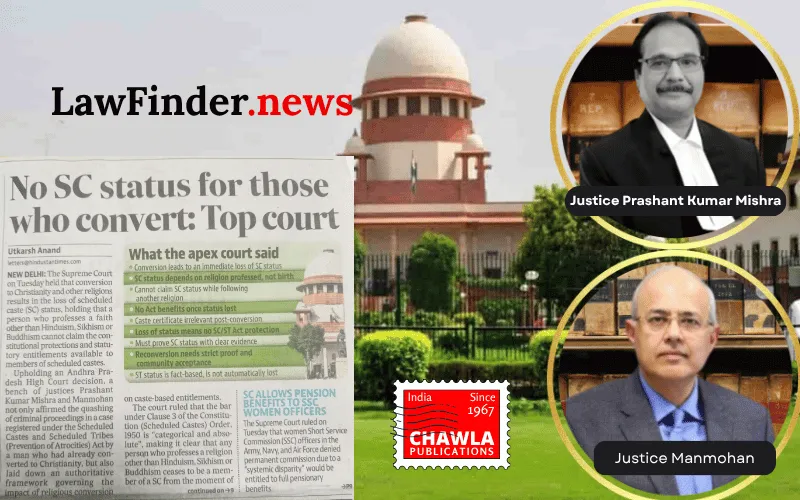
Chinthada Anand's Appeal Dismissed; SC/ST Act Protections Not Available to Christian Converts
In a landmark judgment, the Supreme Court of India has clarified the legal position regarding the Scheduled Caste status of individuals who convert to Christianity, holding that such conversions result in the loss of Scheduled Caste status and the protections afforded under the Scheduled Castes and Scheduled Tribes (Prevention of Atrocities) Act, 1989 (SC/ST Act). The judgment was delivered by a bench comprising Justices Prashant Kumar Mishra and Manmohan in the case of Chinthada Anand v. State of Andhra Pradesh.
The appellant, Chinthada Anand, originally from the Madiga community, a recognized Scheduled Caste, had converted to Christianity and served as a Pastor for over a decade. Anand's appeal challenged the quashing of criminal proceedings against several respondents, who he alleged had assaulted and intimidated him based on caste. The High Court of Andhra Pradesh had previously quashed the proceedings, ruling that Anand, as a Christian convert, could not claim protections under the SC/ST Act.
The Supreme Court, in its analysis, emphasized the importance of Clause 3 of the Constitution (Scheduled Castes) Order, 1950, which explicitly states that no person professing a religion other than Hinduism, Sikhism, or Buddhism shall be deemed a Scheduled Caste. The Court concluded that Anand, by openly professing Christianity, no longer qualified for Scheduled Caste status and thus could not invoke the SC/ST Act.
The Court further upheld the High Court's decision to quash the criminal proceedings for alleged offences under the Indian Penal Code, due to insufficient evidence. The judgment reinforces the legal position that conversion to a religion outside the specified ones in the Constitution (Scheduled Castes) Order results in immediate loss of caste-related statutory benefits.
This ruling has significant implications for individuals who convert to Christianity or other non-specified religions, as it underscores the constitutional and statutory framework governing caste identity and protections in India.
Bottom Line:
A person who professes Christianity cannot claim Scheduled Caste status under Clause 3 of the Constitution (Scheduled Castes) Order, 1950 - Conversion to Christianity results in loss of Scheduled Caste status and statutory protections under the SC/ST Act.
Statutory provision(s): Constitution (Scheduled Castes) Order, 1950 Clause 3, Scheduled Castes and Scheduled Tribes (Prevention of Atrocities) Act, 1989 Sections 3(1)(r), 3(1)(s), 3(2)(va), Indian Penal Code, 1860 Sections 341, 506, 323 read with Section 34, Code of Criminal Procedure, 1973 Section 482
Chinthada Anand v. State of Andhra Pradesh, (SC) : Law Finder Doc id # 2871082