Court emphasizes need for proper procedural compliance under National Medical Commission Act for cognizance of offences
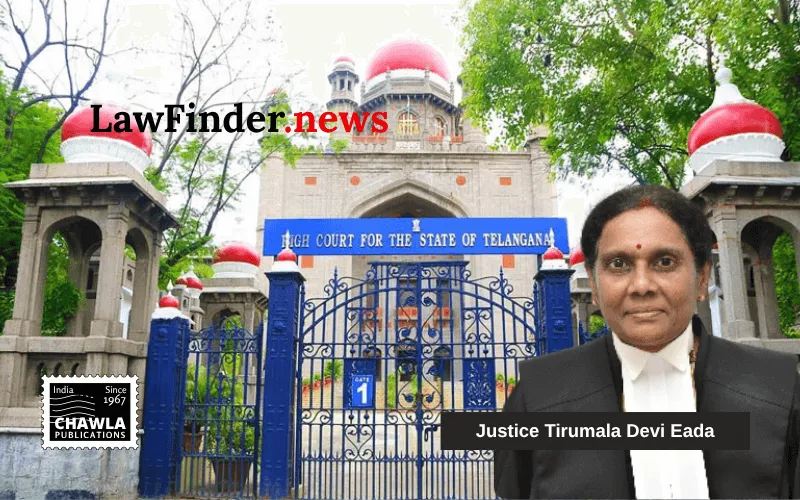
In a significant ruling, the Telangana High Court, presided over by Justice Smt. Tirumala Devi Eada, quashed the criminal proceedings against Dr. Hithendra, a registered Homeopathy practitioner accused of prescribing Allopathy medicines. The decision was delivered on October 29, 2025, in response to a petition seeking to annul the charges filed under several statutory provisions, including the Bharatiya Nyaya Sanhita, 2023, Telangana Medical Practitioners Registration Act, 1968, and the National Medical Commission Act, 2019.
Dr. Hithendra, registered under the Homeopathy system, was alleged to have violated the legal boundaries by practicing Allopathy, prompting charges under Sections 318 and 319 of the Bharatiya Nyaya Sanhita, 2023, along with relevant sections of the Telangana Medical Practitioners Registration Act and the National Medical Commission Act. The core argument revolved around the unauthorized practice of a medical system not covered under the practitioner's registration.
The court's deliberation highlighted a procedural lapse in the manner the complaint was lodged. Justice Eada noted that according to Section 54 of the National Medical Commission Act, a valid complaint regarding such offences must be filed by an authorized officer directly with a competent court, rather than the police. The complaint against Dr. Hithendra was improperly filed with the Station House Officer by the Registrar of the Telangana Medical Council, thus rendering the court's cognizance of the offence invalid.
The court drew upon precedent from the Supreme Court judgment in "Dr. Mukhtiar Chand v. State of Punjab," which clarified that practitioners of one medical system cannot prescribe medicines of another unless explicitly permitted by a State law in force. The High Court observed that the Telangana Medical Practitioners Registration Act does not allow homeopathy practitioners to prescribe allopathic medicines, reinforcing the regulatory boundaries between different medical systems.
Justice Eada underscored the importance of adhering to prescribed procedures under the National Medical Commission Act, emphasizing that the procedural misstep in filing the complaint invalidated the proceedings. Consequently, the court quashed the proceedings against Dr. Hithendra but left the door open for the initiation of fresh proceedings, provided they adhere to the correct legal framework.
This judgment serves as a critical reminder to medical practitioners and regulatory authorities regarding the importance of strict compliance with procedural norms when prosecuting cases of unauthorized medical practice. It also highlights the judiciary's role in ensuring that statutory mandates are observed to maintain the integrity of legal processes in the healthcare sector.
Bottom Line:
A registered practitioner of one system of medicine (e.g., Homeopathy) cannot prescribe medicines of another system (e.g., Allopathy) unless explicitly permitted by a State law in force. A lapse in the procedure, such as filing a complaint before a Station House Officer instead of the competent Court as per Section 54 of the National Medical Commission Act (NMCA), renders the cognizance of the offence invalid.
Statutory provision(s):
Bharatiya Nyaya Sanhita, 2023 Sections 318, 319; Telangana Medical Practitioners Registration Act, 1968 Section 20(ii) read with Section 22; National Medical Commission Act, 2019 Sections 34, 54.
Dr. Hithendra v. State of Telangana, (Telangana) : Law Finder Doc id # 2838446