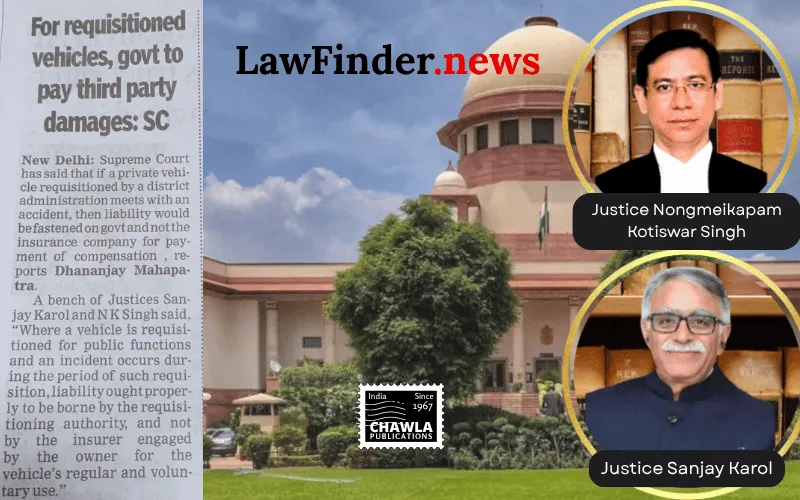
Supreme Court Clarifies Liability in Accidents Involving Requisitioned Vehicles Liability for accidents involving requisitioned vehicles rests with the requisitioning authority, not the private insurer, says Supreme Court.
In a significant ruling, the Supreme Court of India has settled the legal debate over the liability for accidents involving vehicles requisitioned by public authorities for governmental functions. The Court, presided over by Justices Sanjay Karol and Nongmeikapam Kotiswar Singh, delivered its judgment on March 23, 2026, in the case of "District Magistrate and District Election Officer v. National Insurance Company Limited."
The case stemmed from an accident that occurred on January 23, 2010, involving a bus owned by Kidzee Corner School, Gwalior, which was requisitioned by the District Magistrate for Gram Panchayat elections. The bus collided with a motorcycle, resulting in the death of the rider. The legal representatives of the deceased had filed a claim, which was initially awarded by the Motor Accident Claims Tribunal. However, the liability was contested, leading to appeals in the High Court and subsequently, the Supreme Court.
The crux of the Supreme Court's decision was that when a vehicle is requisitioned by a public authority, the ownership and control of the vehicle effectively shift to the State for the duration of the requisition. Consequently, any liability arising from incidents during this period should be borne by the requisitioning authority, not the private insurer engaged by the vehicle's owner for regular use.
The Court referenced previous judgments, including "National Insurance Co. Ltd. v. Deepa Devi" and "Purnya Kala Devi v. State of Assam," to support its decision. The Court emphasized that during requisition, the owner loses control over the vehicle, and the State assumes full responsibility. It further clarified that the insurance policy does not cover the risks associated with the vehicle's use under governmental control, which is outside the scope of regular, private or commercial use.
The judgment also addressed the practice of using requisitioned vehicles with their drivers for public functions, noting that while the Representation of the People Act, 1950 allows for the requisition of vehicles, it does not explicitly cover manpower like drivers. Nonetheless, the liability remains with the State when the vehicle and driver are both deployed for public duties.
This ruling reaffirms the principle that public authorities must bear responsibility for incidents involving vehicles they requisition, thereby relieving private insurers from liability in such cases. It underscores the notion that statutory powers to requisition carry with them the obligation to account for any consequences arising from the compelled use of private property.
Bottom Line:
Liability in cases involving requisitioned vehicles for public functions - When a vehicle is requisitioned by public authorities for governmental functions, the liability for any untoward incidents occurring during such use rests with the requisitioning authority, not the private insurer engaged by the vehicle's owner for regular use.
Statutory provision(s): Motor Vehicles Act, 1988 Section 2(30), Representation of the People Act, 1950 Section 160