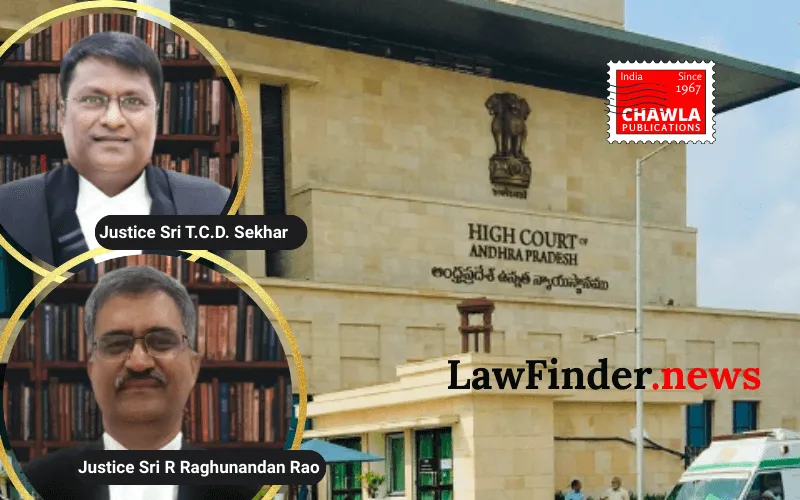
Court emphasizes need for thorough evaluation of integrity allegations in Judicial Officers' confidential reports
In a recent decision, the Andhra Pradesh High Court dismissed a writ petition filed by N. Vijaya Babu, a Judicial Officer, challenging the adverse remarks in his Annual Confidential Report (ACR) for the year 2009. The Division Bench, comprising Justice R. Raghunandan Rao and Justice T.C.D. Sekhar, upheld the integrity-related adverse remarks recorded in Babu's ACR, emphasizing the need for thorough cross-verification of integrity allegations through diverse sources before such remarks are finalized.
The petitioner, N. Vijaya Babu, who was appointed as a Junior Civil Judge in 2008, argued that the adverse remarks were primarily based on discreet inquiries and pending disciplinary proceedings which were later dropped. Despite being exonerated, the adverse remarks concerning his integrity remained, prompting Babu to seek a review from the Registrar Vigilance, which was subsequently denied.
Counsel for the petitioner, V. R. Reddy Kovvuri, contended that discreet inquiries alone should not form the basis for adverse entries in a Judicial Officer's ACR, citing various judgments from the Supreme Court and High Courts. However, the Court noted the absence of any direct directive from the Supreme Court against using discreet inquiries for such evaluations.
The judgment highlighted the importance of ensuring that discreet inquiries are not casual or isolated, but rather comprehensive and corroborated by inputs from various sources. The Court acknowledged the potential for disgruntled individuals to make unfounded allegations against Judicial Officers, particularly concerning their integrity. Therefore, it emphasized the need for a balanced approach to protect honest officers while addressing genuine concerns.
Despite dismissing the petition, the Court advised caution in recording adverse remarks, urging that they be substantiated by diverse and reliable inputs, not solely on discreet inquiries or reports from a single source such as a Principal District Judge.
The decision underscores the complex balance between maintaining the integrity of the judiciary and protecting Judicial Officers from potentially unfounded allegations. The Court's ruling serves as a reminder of the critical need for transparency and fairness in evaluating the performance and integrity of Judicial Officers.
Bottom Line:
Confidential Report of Judicial Officer - Discreet enquiries cannot form the sole basis for adverse remarks in Annual Confidential Report, especially concerning integrity, unless such allegations are cross-checked and substantiated with inputs from diverse sources.
Statutory provision(s): Articles 14 and 21 of the Constitution of India
N.Vijaya Babu v. Honble High Court of AP, (Andhra Pradesh)(DB) : Law Finder Doc id # 2864397