Supreme Court Quashes FIR: Directs Exhaustion of Statutory Remedies Before Invoking Writ Jurisdiction, Supreme Court emphasizes the need for exhausting alternative remedies under Bharatiya Nagarik Suraksha Sanhita, 2023 before seeking High Court intervention for FIR registration.
In a landmark judgment, the Supreme Court of India has quashed an FIR registered against Sujal Vishwas Attavar and others, asserting that the High Court misused its writ jurisdiction under Article 226 of the Constitution by directing the registration of the FIR without exhausting alternative statutory remedies. The case, Sujal Vishwas Attavar v. State of Maharashtra, pivots around a commercial dispute involving allegations of forgery, impersonation, and fraud.
The controversy began when the complainant, E & G Global Estates Ltd., accused the appellants of using forged documents to assert control over a property in Nashik. After their initial complaints to the Land Records Authority and the police did not result in an FIR, the complainant approached the Bombay High Court. The High Court, without issuing notice, directed the police to take action, resulting in the registration of FIR No. 0194/2025 against the appellants.
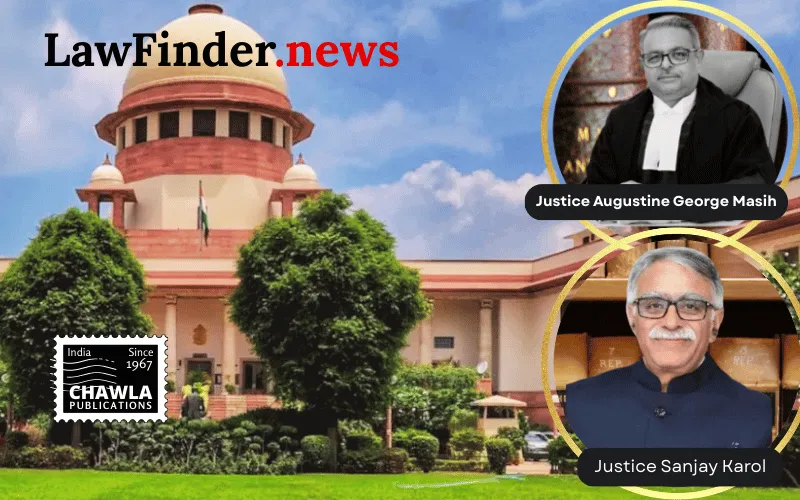
The Supreme Court, led by Justices Sanjay Karol and Augustine George Masih, highlighted the importance of adhering to the statutory framework provided under the Bharatiya Nagarik Suraksha Sanhita, 2023. The judgment underscores that remedies like approaching the Superintendent of Police or a Magistrate must be pursued before invoking the High Court's writ jurisdiction unless exceptional circumstances such as the violation of fundamental rights are present.
Referencing precedents like "Radha Krishan Industries v. State of H.P." and "Sakiri Vasu v. State of U.P.", the Court reiterated that the writ jurisdiction is extraordinary and discretionary, intended as a last resort when statutory remedies are inadequate or unavailable. The Court noted that the complainant neither approached the concerned authorities under BNSS nor demonstrated the inefficacy of these remedies before seeking judicial intervention.
Concluding the judgment, the Supreme Court set aside the High Court's order and quashed the FIR, granting the complainant the liberty to pursue appropriate statutory remedies. This decision reinforces the principle that judicial intervention should not bypass established legal procedures, thereby upholding the integrity of statutory frameworks designed for criminal proceedings.
Bottom Line:
High Court cannot exercise writ jurisdiction under Article 226 to order the registration of an FIR when alternative statutory remedies under the Bharatiya Nagarik Suraksha Sanhita, 2023 (BNSS) are available and have not been exhausted.
Statutory provision(s): Article 226 of the Constitution of India, Sections 173(1), 173(4), 175(3) of the Bharatiya Nagarik Suraksha Sanhita, 2023, Sections 318, 319, 336, 340 of the Bharatiya Nyaya Sanhita, 2023
Sujal Vishwas Attavar v. State of Maharashtra, (SC) : Law Finder Doc id # 2892749