Court holds that allegations against MLA amount to law and order issues, not public order disturbance; delays and non-furnishing of full detention record vitiated detention order under Jammu and Kashmir Public Safety Act, 1978
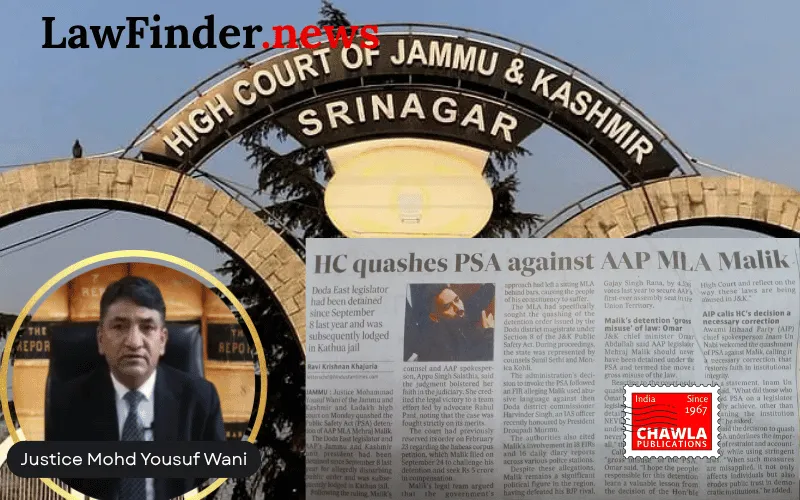
In a landmark judgment dated April 27, 2026, the Jammu and Kashmir High Court quashed the preventive detention order issued against Mehraj Din Malik, an elected Member of Legislative Assembly (MLA) from Doda East constituency, under the Jammu and Kashmir Public Safety Act, 1978 (PSA). The court held that the detention was illegal and unsustainable as the allegations against the petitioner pertained primarily to law and order violations, which do not meet the threshold for disturbance of public order necessary for preventive detention.
The detention order, passed by the District Magistrate, Doda, was predicated on a dossier comprising 18 FIRs and 16 Daily Diary Reports (DDRs) spanning over a decade (2014–2025). Many FIRs related to alleged violations of the Model Code of Conduct during elections and protests against administrative decisions. The court observed that several FIRs had been compounded or withdrawn, while others were pending trial, indicating that the ordinary criminal justice system was already engaged.
The court emphasized the critical legal distinction between "law and order" and "public order," referencing authoritative Supreme Court judgments including Ram Manohar Lohia v. State of Bihar and Arun Ghosh v. State of West Bengal. It held that public order involves disturbances affecting the community at large, while law and order concerns more localized or individual offenses. Since the petitioner’s alleged actions did not cause or threaten such wide-scale disruption, the preventive detention was unwarranted.
Additionally, the court found procedural infirmities in the detention process. The petitioner was not furnished with the entire detention record, notably videos relied upon by the detaining authority, which impaired his ability to make an effective representation. The court also noted the inordinate delay of 18 days in deciding the petitioner’s representation against detention, which further vitiated the order.
While the detaining authority alleged that the petitioner’s activities included inciting communal disharmony and glorifying militants, the court found these claims unsubstantiated on the record before it. It also rejected the contention of bias or malafide on the part of the detaining authority, but held that the detention order exhibited non-application of mind since the grounds did not justify preventive detention.
The judgment underscored that preventive detention laws are extraordinary and must be invoked with utmost caution, only when ordinary law enforcement is inadequate to maintain public order. The court reiterated the fundamental right to personal liberty under Article 21 of the Constitution and the safeguards under Article 22(5), which require timely and full communication of grounds of detention and prompt consideration of representations.
The High Court directed the immediate release of Mehraj Din Malik from detention and ordered the return of the detention record to the State authorities. This ruling reinforces judicial vigilance against misuse of preventive detention powers, especially against elected representatives, and affirms that preventive detention cannot substitute for criminal prosecution where ordinary laws suffice.
Bottom Line:
Preventive detention under Jammu and Kashmir Public Safety Act, 1978 (PSA) cannot be sustained if the allegations amount only to law and order issues and do not reach the threshold of public order affecting the community at large; delay in deciding representation and non-furnishing of full detention record including videos vitiate the detention order.
Statutory provision(s):
Jammu and Kashmir Public Safety Act, 1978 Section 8(1)(a)(ii), Section 8(3)(b), Article 21 and Article 22(5) of the Constitution of India
Mehraj Din Malik v. Union Territory of J&K, (Jammu And Kashmir) : Law Finder Doc id # 2889621