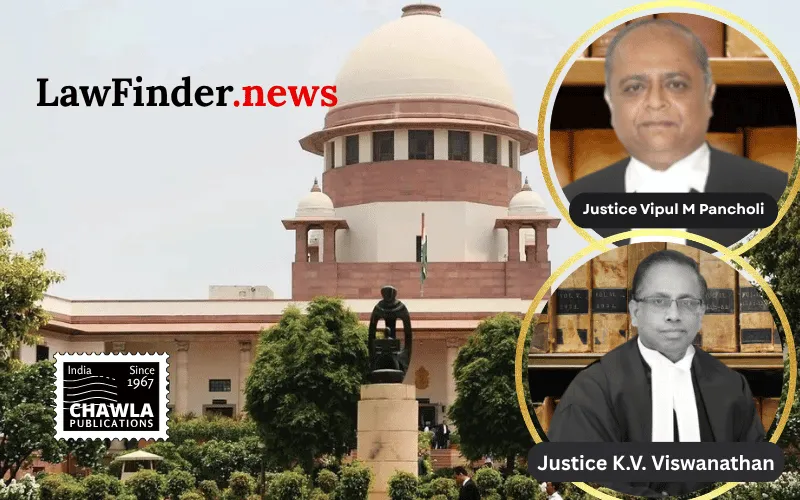
Supreme Court Upholds CoC's Decision to Liquidate Corporate Debtor, Dismisses Appeals by Sanjay Dave, Supreme Court affirms that a successful resolution applicant cannot withdraw from an approved resolution plan, emphasizing the binding nature of CoC's commercial wisdom.
In a significant ruling, the Supreme Court of India has upheld the decision of the Committee of Creditors (CoC) to liquidate Oracle Home Textiles Limited, following the failure of the successful resolution applicant, Sanjay Dave, to comply with the resolution plan. The judgment, delivered by Justices K.V. Viswanathan and Vipul M. Pancholi, dismissed the appeals challenging the National Company Law Appellate Tribunal's (NCLAT) decision, thereby reinforcing the sanctity of CoC's commercial decisions under the Insolvency and Bankruptcy Code, 2016.
The case revolves around the Corporate Insolvency Resolution Process (CIRP) of Oracle Home Textiles Limited, where Sanjay Dave, the appellant and promoter, had his resolution plan approved by a 99.90% voting majority of the CoC. However, issues arose when the appellant failed to accept the Letter of Intent (LoI) issued by the Resolution Professional, which he claimed was conditional. Despite multiple opportunities and extensions, Dave did not comply with the necessary performance guarantees, leading to the forfeiture of his earnest money deposit.
The Supreme Court's judgment emphasized that once a resolution plan is approved by the CoC, the successful resolution applicant cannot renegotiate or withdraw based on alleged conditionalities in the LoI. The Court also noted that the CoC's decision to liquidate the Corporate Debtor was a collective business decision, taken with a 99.61% voting majority, and was not subject to judicial review except for compliance with statutory provisions.
The Court further stated that any attempt by a successful resolution applicant to renege from an approved plan undermines the objectives of the Insolvency and Bankruptcy Code, which aims for a swift and time-bound resolution process. The judgment clarifies that the commercial wisdom of the CoC is paramount and non-justiciable, reaffirming the importance of adhering to the timelines and procedures outlined in the Code.
This ruling is expected to have far-reaching implications on the insolvency resolution process in India, ensuring that CoC's decisions are respected and that resolution applicants cannot delay or derail the process through non-compliance.
Bottom Line:
Once the CoC has approved the resolution plan, the successful resolution applicant (SRA) cannot renegotiate or withdraw from the plan citing alleged conditions in the Letter of Intent (LoI). The CoC's commercial wisdom is paramount and not subject to judicial review unless statutory provisions are violated.
Statutory provision(s): Insolvency and Bankruptcy Code, 2016 Sections 31, 33, 62
Sanjay Dave v. Andhra Bank Ltd., (SC) : Law Finder Doc id # 2907497