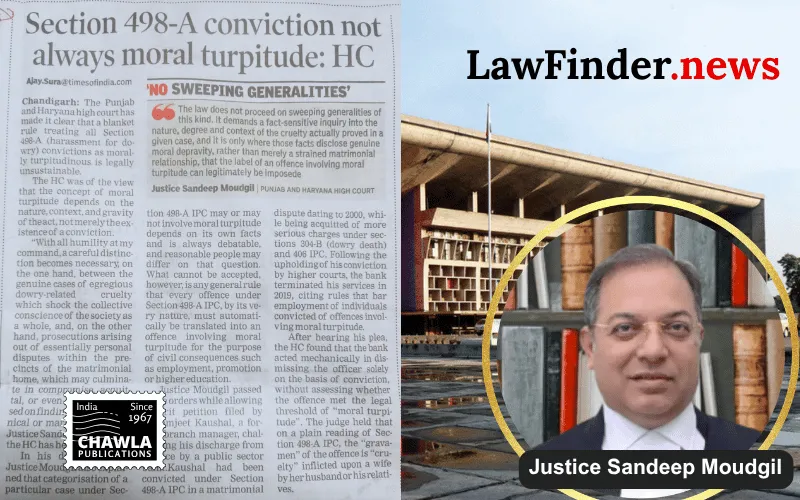
Court mandates reinstatement and restoration of benefits, emphasizing need for factual analysis in cases of alleged moral turpitude.
In a significant judgment, the Punjab and Haryana High Court has set aside the dismissal of Brahmjeet Kaushal, a bank employee who was discharged from service after being convicted under Section 498A of the Indian Penal Code (IPC). The court ruled that the conviction does not automatically constitute an offense involving moral turpitude without a thorough fact-sensitive inquiry into the nature and context of the offense.
The case stems from an FIR registered in 2000 against Kaushal and his family members, alleging demand for dowry and abetment of suicide by his deceased wife. The Sessions Court acquitted him of charges under Sections 304-B and 406 IPC but convicted him under Section 498A IPC. Consequently, the bank discharged him from service, citing the conviction as an offense involving moral turpitude.
Justice Sandeep Moudgil, presiding over the case, emphasized the need for disciplinary authorities to evaluate the nature of the offense, its nexus with official duties, and the proportionality of punishment. The court held that a conviction arising from a matrimonial dispute does not automatically meet the criteria for moral turpitude, which involves inherent baseness or depravity.
The judgment referenced various Supreme Court rulings, including Allahabad Bank v. Deepak Kumar Bhola and Pawan Kumar v. State of Haryana, underscoring the necessity for a nuanced approach in determining moral turpitude. The court noted that the disciplinary authority failed to conduct a detailed analysis and relied on a mechanical interpretation of the conviction.
The court directed the bank to reinstate Kaushal and grant all consequential benefits, including interest, within two months. This decision highlights the judiciary's commitment to ensuring fair and proportional treatment in employment matters, particularly when personal disputes intersect with professional consequences.
Bottom Line:
Conviction under Section 498A IPC does not automatically constitute an offence involving moral turpitude without a fact-sensitive inquiry into the nature and context of the offense.
Statutory provision(s): Section 498A IPC, Section 304B IPC, Section 406 IPC, Article 226 of the Constitution of India, Banking Regulation Act, 1949 Section 10(1)(b)(i), State Bank of India Officers' Service Rules, 1992 Rule 68(7)(i).
Brahmjeet Kaushal v. Union of India, (Punjab And Haryana) : Law Finder Doc id # 2867956