New Delhi, May 27 Observing that the Election Commission's supervisory authority is “inherently expansive”, the Supreme Court on Wednesday upheld its authority to conduct the Special Intensive Revision (SIR) of electoral rolls, saying its powers under the Constitution cannot be curtailed merely because Parliament made a law on elections.
Article 324 of the Constitution deals with the EC’s powers and says, “The superintendence, direction and control of the preparation of the electoral rolls for, and the conduct of, all elections to Parliament and to the Legislature of every State and of elections to the offices of President and Vice-President held under this Constitution shall be vested in a Commission (referred to in this Constitution as the Election Commission).”
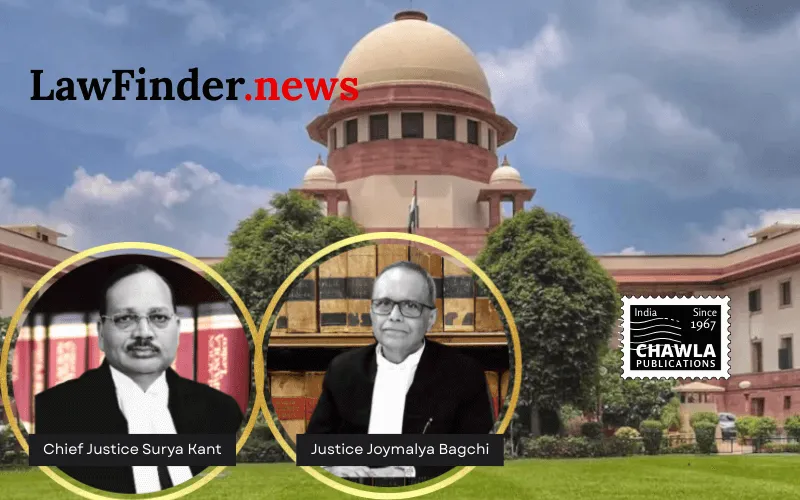
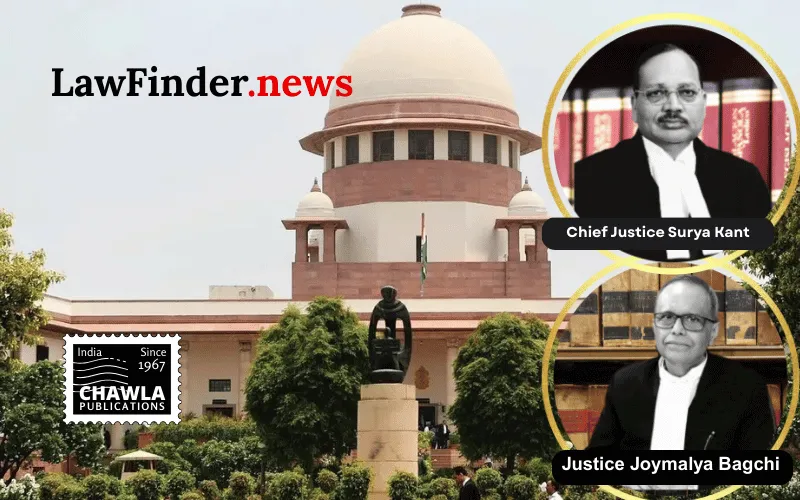
Delivering a major victory for the Election Commission, a bench comprising Chief Justice Surya Kant and Justice Joymalya Bagchi upheld its power to conduct an SIR of voter rolls and discussed in detail the constitutional scheme and the provisions of the Representation of People Act (RPA).
In a 124-page judgment, the CJI answered in affirmative the question whether the Election Commission has power to conduct the impugned SIR.
The bench ruled that the EC’s constitutional mandate to ensure free and fair elections is "expansive" and cannot be "extinguished" or "paralysed" by parliamentary legislation.
“We hold that the impugned SIR neither stands in direct conflict with the RPA and the 1960 Rules, nor does it detract from the constitutional imperative of free and fair elections. It is, instead, an exercise traceable to Section 21(3) of the RP Act read with Article 324 of the Constitution, undertaken to advance the very objective which Part XV of the Constitution is designed to protect,” it said.
A plain reading of Articles 324 and 327 shows that they are not competing repositories of power, it said.
“Article 324 vests the constitutional function of superintendence, direction and control of preparation of electoral rolls in the Commission. Article 327 enables Parliament to make law in relation to elections, including preparation of electoral rolls, but expressly makes such law making power ‘subject to the provisions of this Constitution’,” the verdict said.
The bench opined that the proposition advanced by the petitioners, opposed to the SIR, that Article 324 operates exclusively in the residual interstices completely untouched by statute is “legally untenable”.
“It is incorrect to posit that once Parliament legislates on a particular subject, the Commission is entirely disabled from exercising its vested constitutional powers. The Commission inherently possesses the jurisdiction to issue directions of a general and regulatory character to effectuate the constitutional purpose entrusted to it. Parliament by legislating under Article 327 does not reduce Article 324 to a dead letter,” it held.
It said the EC’s supervisory authority is “inherently expansive”. Functioning as a continuous wellspring of power, it encompasses every facet and stage of the electoral machinery to ensure the sanctity of the democratic process.
“The Commission retains the absolute constitutional mandate to step into vacuous areas left unoccupied by legislation. In situations where the enacted laws and rules are silent or inadequate to meet emerging contingencies, the Commission is empowered to take necessary steps that will ensure the purity of the electoral process,” it said.
Observing that the constitutional equilibrium rests upon a delicate balance, it said although the EC’s power under Article 324 is plenary, it must be exercised with due regard to parliamentary law, including statutory prohibitions.
“Parliamentary law may illuminate the exercise of that constitutional power, but it cannot be applied or construed in a manner that emasculates or extinguishes the Commission’s overriding constitutional mandate to secure free and fair elections,” it said.
It said the impugned SIR does not supplant the RPA or the 1960 Rules.
“It rather breathes life into the constitutional mandate of Article 324 through the precise statutory conduit provided by Section 21(3). Therefore, it cannot be said that the Commission has acted in the teeth of an express statutory prohibition…” it said.
So long as the Commission acts within the bounds of the statute, records reasons for recourse to the special power, and does not transgress any express prohibition contained in the Act or the Rules, the exercise cannot be struck down as ultra vires merely because it adopts a procedure different from that applicable to an ordinary revision, it held.
The bench expressed satisfaction that, in its object and design, the impugned SIR bears a direct nexus to the constitutional goal of a free and fair election.
“Free and fair elections do not rest merely upon the mechanics of polling. They equally depend upon the integrity, accuracy and purity of the electoral roll which forms the foundation of the democratic process.
“The reasons recorded by the Commission, namely the passage of more than two decades since the last intensive revision, large-scale additions and deletions over that period, rapid urbanisation, migration, and the resulting possibility of repeated or defective entries, are plainly directed towards preserving that foundational integrity,” it said.